
Courier Portal Role in Clinic Workflow: 2026 Guide
Discover the vital role of courier portal in clinic workflow. Learn how it boosts efficiency, speeds up deliveries, and enhances patient care.

Courier Portal Role in Clinic Workflow: 2026 Guide
***
> TL;DR: > > - A courier portal centralizes clinic logistics by managing orders, tracking, and billing within a single system. It improves workflow efficiency through automation, reduces manual data entry, and lowers call volume. HIPAA compliance and proper onboarding are crucial for integrating the portal successfully into clinical operations.
***
A courier portal is an integrated digital platform that centralizes clinic courier logistics by managing order placement, dispatch, real-time tracking, and billing within a single system. The role of courier portal in clinic workflow extends far beyond moving packages. It determines how quickly specimens reach labs, how accurately billing gets reconciled, and how much time your staff spends on the phone chasing delivery updates instead of caring for patients. For healthcare administrators and clinic managers, understanding this technology is now a core operational responsibility, not an IT afterthought.
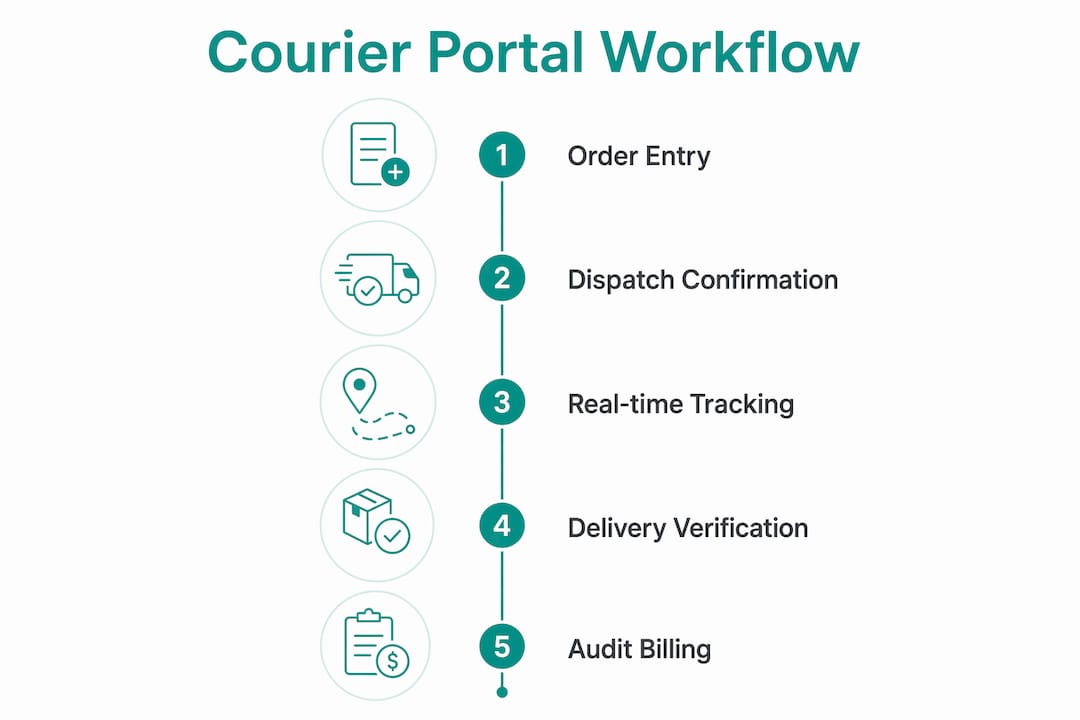
How does a courier portal improve clinic workflow efficiency?
Automation is the primary mechanism through which courier portals change clinic operations. Integrated courier management systems can substantially reduce manual data entry and billing errors after full deployment. That single shift frees your front-desk and billing staff from repetitive reconciliation tasks and redirects their attention to patient-facing work.

Call volume is another measurable gain. Self-service courier portals can substantially reduce shipment inquiry calls after adoption. Fewer inbound calls about delivery status means your staff can focus on scheduling, prior authorizations, and clinical support rather than acting as a courier tracking service.
Order processing accuracy also improves significantly. Portal-based systems can eliminate billing errors that are common in manual, paper-based workflows. Each prevented error reduces the risk of a denied claim, a delayed payment, or a compliance flag during an audit.
The operational logic is straightforward. When order entry, dispatch confirmation, delivery verification, and invoice generation all live in one system, there are no handoff gaps where data gets lost or duplicated. The result is a tighter, faster, and more reliable logistics cycle that supports the broader clinical operation.
Pro Tip: Before selecting a courier portal, map your current order-to-delivery workflow on paper. Identify every step where staff manually re-enter data or make a phone call. Those friction points are exactly where a well-integrated portal delivers the most measurable relief.
What features define an effective courier portal in clinical settings?
The capabilities of a courier portal determine how well it fits into a clinical environment. Not every platform built for commercial logistics meets the standards hospitals and clinics require.
Real-time tracking is the baseline expectation. Hospitals now require courier partners to provide real-time tracking, automated updates, and compliance documentation as a condition of partnership. Manual status updates are treated as an operational risk, not a minor inconvenience.
Beyond tracking, effective portals provide automated exception alerts. When a specimen pickup is delayed, a temperature excursion is detected, or a delivery window is missed, the portal notifies the relevant staff immediately. This prevents the silent failures that only surface hours later when a lab calls to report a missing sample.
Chain of custody documentation is equally critical. A portal that logs each handoff, timestamps each scan, and stores that data in an audit-ready format gives your clinic defensible records for regulatory reviews. Temperature monitoring integration adds another layer of specimen integrity protection for time-sensitive or cold-chain materials.
| Feature | Clinical benefit |
|---|---|
| Real-time tracking | Confirms specimen location at every stage of transit |
| Automated exception alerts | Notifies staff of delays or failures before they escalate |
| Chain of custody logging | Provides audit-ready records for regulatory compliance |
| Temperature monitoring | Protects specimen integrity for cold-chain materials |
| Automated billing reconciliation | Reduces end-of-day errors and disputed invoices |
Courier portals that automate the full delivery lifecycle, from digital requisition through to audit-ready billing, build the kind of operational confidence that clinical administrators need to trust their logistics partner completely.
What compliance and risk considerations apply to courier portals in healthcare?
HIPAA compliance is not optional for any software system that touches protected health information, and courier portals are no exception. HIPAA regulations require that courier portals and all subcontractor software components operate under signed Business Associate Agreements. This obligation extends to every third-party tool the courier vendor uses, not just the primary platform.
The liability exposure here is direct. If a courier's portal or a subcontractor's software experiences a data breach and no BAA is in place, your clinic may share regulatory liability. Administrators must verify BAA coverage before signing any courier contract, not after onboarding is complete.
Chain of custody documentation also carries compliance weight. A portal that creates a timestamped, tamper-evident record of every specimen handoff supports both HIPAA audit readiness and clinical quality standards. Without that record, a disputed delivery becomes a he-said-she-said situation with no resolution path.
For clinics that handle sensitive specimens, such as oncology samples, genetic material, or controlled substances, the documentation requirements are even more stringent. Your courier portal must generate records that satisfy both federal regulations and any applicable state-level requirements. Reviewing HIPAA-aware courier workflows before finalizing a vendor agreement is a practical first step.
Pro Tip: Request a copy of your courier vendor's BAA template before the sales process concludes. Review it with your compliance officer or legal counsel. A vendor that hesitates to provide this document early is a vendor worth reconsidering.
How do you integrate a courier portal into your clinic's existing workflow?
Integration planning determines whether a courier portal becomes a genuine operational asset or a parallel system your staff works around. The process requires deliberate sequencing and realistic timelines.
Vendor onboarding in healthcare can take several weeks or months from contract execution to full operational deployment. Build that window into your planning calendar. Clinics that underestimate this timeline often find themselves managing two systems simultaneously during the transition, which creates the exact inefficiencies the portal was meant to eliminate.
The integration sequence that works best follows four steps.
- Audit your current systems. Identify your Electronic Health Record (EHR), Laboratory Information System (LIS), and any existing dispatch or billing tools. Document how data currently flows between them and where manual steps occur.
- Define your integration requirements. Determine which data fields must sync between the courier portal and your EHR or LIS. Specimen IDs, requisition numbers, and patient identifiers are the most common connection points. Confirm your courier vendor supports these integrations before signing.
- Set service-level agreements (SLAs) in writing. Specify pickup windows, delivery timeframes, escalation procedures, and response times for exceptions. SLAs give your clinic a contractual basis for performance accountability and protect you if service quality declines.
- Train clinical and administrative staff together. Courier portal adoption fails most often because clinical staff and billing staff are trained separately, creating inconsistent usage patterns. A joint training session that walks through the full order-to-invoice cycle prevents the gaps that generate errors later.
Clinics that align their courier service onboarding process with these steps consistently report faster time-to-value and fewer post-launch corrections. The goal is a portal that your staff uses naturally, not one that requires constant workarounds.
Key Takeaways
A courier portal reduces manual clinic logistics work, eliminates billing errors, and creates the compliance documentation your practice needs to pass an audit and protect patient outcomes.
| Point | Details |
|---|---|
| Automation reduces manual work | Integrated portals substantially reduce manual data entry, freeing staff for patient care. |
| Call volume drops significantly | Self-service portals substantially reduce shipment inquiry calls post-adoption. |
| HIPAA compliance requires BAAs | Every courier portal and its subcontractors must operate under signed Business Associate Agreements. |
| Onboarding takes 60–120 days | Plan vendor integration timelines carefully to avoid running parallel systems during transition. |
| SLAs protect clinic operations | Written service-level agreements give clinics contractual accountability for courier performance. |
Why courier portals are more than a logistics upgrade
I have spent years watching clinic administrators treat courier selection as a procurement checkbox. They compare price per pickup, confirm the vendor has a van and a license, and move on. That approach consistently produces the same outcome: a transactional relationship that breaks down the moment volume increases or a compliance question arises.
The shift I have seen in well-run practices is treating the courier portal as an extension of the clinical workflow, not a separate vendor relationship. When courier selection affects clinical pathways, poor integration forces manual syncing and rework loops that directly affect patient outcomes. That is not a logistics problem. That is a patient care problem.
What I find most underappreciated is the concept of operational stickiness. Courier portals create integration depth around specimen IDs, requisitions, and billing records that raises the cost of switching vendors. Clinics that build this depth with the right partner gain long-term stability. Clinics that skip it remain vulnerable to service disruptions with no easy path to recovery.
My practical advice: evaluate your courier partner the same way you evaluate an EHR vendor. Ask for a live portal demonstration, request references from clinics with similar specimen volumes, and confirm BAA coverage before the conversation gets to pricing. The portal is the relationship. Everything else is logistics.
> — Copergrine Editorial Team
***
Copergrine's courier portal for clinical workflow integration
Copergrine is built specifically for clinics that need logistics, clinical care, and documentation to work as one connected system. Its medical courier service includes real-time tracking, chain of custody documentation, and same-day delivery across the Greater Houston area, all accessible through an integrated portal designed for clinical environments.
Copergrine's platform connects courier logistics directly with its proprietary EMR system, eliminating the manual data transfers that create billing errors and compliance gaps. For clinic managers evaluating courier portal options, Copergrine offers a technology-driven partnership that meets hospital-grade compliance standards without requiring a separate integration project. Contact Copergrine to discuss how its courier and EMR infrastructure can fit your clinic's specific workflow requirements.
***
FAQ
What is the role of a courier portal in clinic workflow?
A courier portal centralizes order management, dispatch, real-time tracking, and billing into one system. This eliminates manual data entry, reduces call volume, and creates audit-ready documentation for compliance purposes.
How do clinic courier contracts work with portal-based systems?
Clinic courier contracts with portal integration typically include defined SLAs for pickup windows, delivery timeframes, and exception response times. Contracts must also include a Business Associate Agreement covering all software components that handle protected health information.
How long does courier portal onboarding take for a clinic?
Vendor registration and onboarding for healthcare courier services can take several weeks or months from contract execution to full deployment. Clinics should plan this window into their operational calendar to avoid running parallel systems.
What compliance requirements apply to courier portals in healthcare?
HIPAA requires that courier portals and all subcontractor software operate under signed Business Associate Agreements. Clinics that skip this step may share direct liability for any data breach involving the courier's platform.
How do courier portals affect billing accuracy in clinical settings?
Portal-based systems eliminate the billing errors common in manual workflows, including approximately 8 errors per month found in paper-based logs. Automated delivery logging and reconciliation remove the documentation mismatches that generate disputed invoices.