
Courier Service Onboarding Clinic Guide for 2026
Master the courier service onboarding clinic guide for 2026. Ensure compliance, reduce errors, and streamline your medical delivery workflows.

Courier Service Onboarding Clinic Guide for 2026
Courier service onboarding is the structured process of integrating a medical delivery vendor into your clinic's workflows, compliance framework, and documentation systems. A complete courier service onboarding clinic guide covers vendor credentialing, chain-of-custody protocols, HIPAA obligations, and internal workflow mapping before a single specimen leaves your facility. Clinics that skip formal onboarding expose themselves to regulatory liability, delivery errors, and broken chain-of-custody records. The good news is that a disciplined process, built around clear prerequisites and documented workflows, produces reliable, compliant logistics from day one.
***
What legal, certification, and insurance requirements must clinics verify?
Every courier service onboarding process begins with a compliance audit of the vendor. Healthcare procurement teams prize professionalism and compliance over low-cost delivery when choosing courier partners. That priority reflects real risk: a courier without proper credentials creates direct liability for your clinic.
The core verification checklist covers five areas:
- Commercial auto insurance. Confirm the courier carries valid commercial auto insurance with coverage limits appropriate for medical transport. Personal auto policies do not cover commercial medical delivery.
- DOT/IATA Category B training. Couriers transporting biological specimens must complete DOT/IATA Category B biological substance training. This training typically costs $100–$300 and takes a few hours, making it a low barrier that every legitimate partner should clear.
- Background checks and license verification. Background checks and license verification with photographic records and expiration date validation are standard requirements. Completeness alerts in your onboarding system prevent submission of expired or invalid files.
- HIPAA compliance and Business Associate Agreements. Any courier handling protected health information must sign a Business Associate Agreement (BAA) before the first pickup. No BAA means no contract.
- Vendor Qualification Packet. Require the courier to submit a single packet containing all registration documents, insurance certificates, HIPAA acknowledgments, and training completions. This packet significantly speeds onboarding by eliminating repeated back-and-forth requests.
For clinics operating in regulated environments such as hospitals, VA facilities, or reference labs, vendor credentialing portals like Reptrax and Vendormate add another layer of verification. Confirm whether your facility requires portal registration before finalizing any courier agreement.
Pro Tip: Prepare your own internal checklist that mirrors the Vendor Qualification Packet structure. When a courier submits incomplete documents, you can identify the exact gap immediately rather than sorting through a disorganized submission.
***
How should clinics map internal workflows before integrating a courier?
Workflow mapping is the step most clinic administrators skip, and it is the step most responsible for onboarding failures. Automating undefined courier workflows causes errors rather than preventing them. You cannot hand a courier a route until you have documented exactly what they are picking up, from where, and under what conditions.
A practical workflow mapping process follows four steps:
- Document every specimen collection point. Walk each department and list where specimens originate, including exam rooms, phlebotomy stations, and satellite collection areas. Note the volume and frequency at each point.
- Define the handoff station. Designate a single, labeled pickup station per floor or building. Couriers should never retrieve specimens directly from clinical areas without a formal handoff protocol.
- Write the chain-of-custody procedure. Specify who signs off at pickup, what documentation travels with the specimen, and what confirmation the courier must provide at delivery. This procedure becomes the contractual standard for your courier partner.
- Assign internal communication contacts. Name the staff member responsible for courier coordination on each shift. Couriers need a direct contact for schedule changes, access issues, and urgent STAT requests.
Mapping clinic workflows before couriers arrive allows clinics to identify and close process gaps, minimizing onboarding delays and delivery errors. The map also becomes your training document for new staff and a reference point when performance issues arise.
Pro Tip: Require couriers to use your clinic's EMR-integrated tracking system rather than their proprietary app. Using clinic EMR tracking eliminates data silos and gives your clinical team real-time delivery visibility without switching platforms.

***
What are the step-by-step actions for a successful courier onboarding?
A structured courier service setup checklist moves from vendor identification through operational launch in a predictable sequence. Full vendor credentialing typically takes 2–6 weeks, though specialized partners can implement structured daily routes within 48 hours. Plan for the longer timeline and treat the 48-hour option as a contingency for urgent operational needs.
The sequence breaks into six phases:
- Phase 1: Identify and vet candidates. Set a minimum benchmark of a 99%+ on-time delivery rate for any courier under consideration. Request references from current healthcare clients and verify those references directly.
- Phase 2: Request and review the Vendor Qualification Packet. Collect all credentials before scheduling any operational meetings. Reviewing documents first prevents wasted time with non-compliant vendors.
- Phase 3: Complete credentialing portal registration. If your facility uses Reptrax, Vendormate, or a similar system, initiate registration immediately after document review. Portal approvals add time to the timeline and cannot be rushed.
- Phase 4: Configure GPS tracking and delivery confirmation. Set up the tracking integration within your clinic's EMR or logistics management system. Confirm the courier's drivers can access and operate the system before go-live.
- Phase 5: Conduct trial runs. Run at least three trial pickups covering both STAT deliveries and scheduled routes. Evaluate timing, documentation accuracy, and driver conduct during each trial.
- Phase 6: Launch and monitor. Move to live operations only after trial runs meet your benchmarks. Assign a staff contact to monitor performance daily for the first two weeks.
The table below summarizes the timeline and key outputs for each phase.
| Phase | Action | Expected Output |
|---|---|---|
| 1. Vetting | Review credentials and references | Qualified candidate list |
| 2. Documentation | Collect Vendor Qualification Packet | Complete compliance file |
| 3. Credentialing | Register in portal (Reptrax, Vendormate) | Portal approval confirmation |
| 4. System setup | Configure EMR tracking and GPS | Live tracking access |
| 5. Trial runs | STAT and scheduled route tests | Performance baseline data |
| 6. Go-live | Launch with daily monitoring | Verified operational courier |
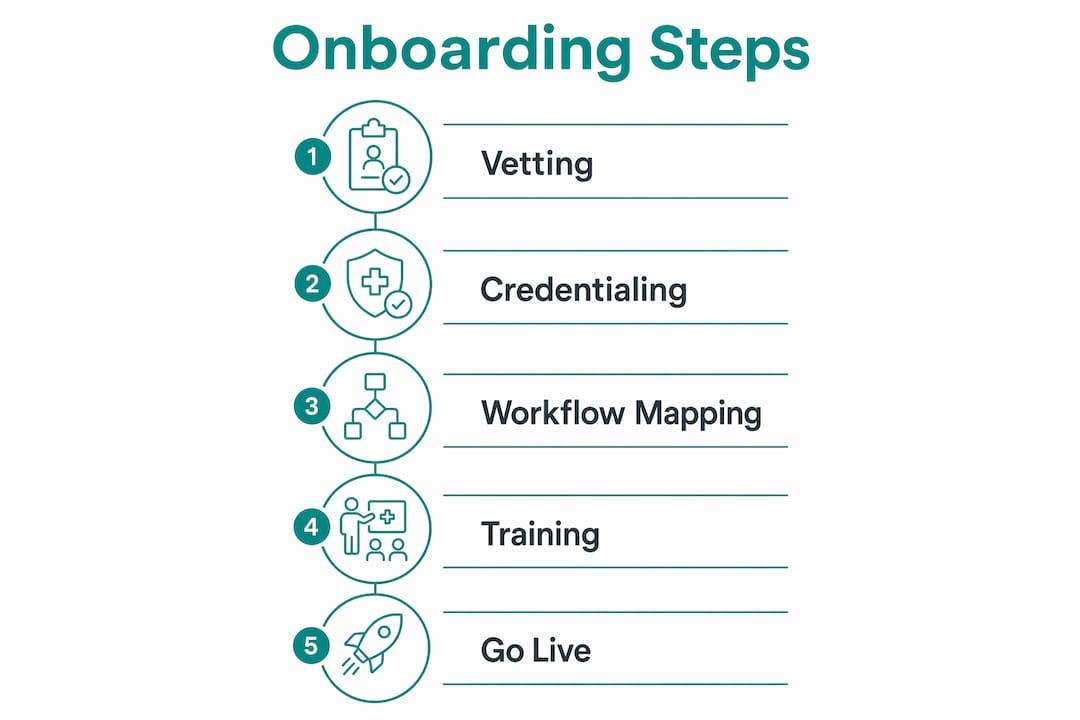
Clinics that compress this process without completing each phase typically encounter chain-of-custody gaps or compliance findings during audits. The two-to-six-week timeline exists for good reason.
***
How do clinics evaluate ongoing courier reliability and manage onboarding challenges?
Onboarding does not end at go-live. Clinic logistics management requires continuous performance review to catch problems before they affect patient care. Healthcare procurement teams expect couriers to maintain strong service standards throughout the contract, not just during the evaluation period.
Three metrics define reliable courier performance in a clinical setting:
- Delivery timing accuracy. Track on-time rates against the agreed schedule for every pickup and delivery. A single missed STAT pickup can delay a diagnosis.
- Chain-of-custody accuracy. Review documentation completeness after each delivery. Missing signatures or incomplete logs are compliance failures, not administrative oversights.
- Compliance adherence. Confirm that drivers consistently follow your facility's access protocols, dress code, and identification requirements.
Common onboarding pitfalls fall into three categories. First, unclear workflows cause couriers to improvise, which breaks chain-of-custody. Second, missing documentation at go-live forces clinics to operate with unverified vendors. Third, siloed tracking systems create visibility gaps that clinical staff cannot resolve without contacting the courier directly.
> "The true onboarding bottleneck is not credentialing paperwork. It is the absence of a documented, agreed-upon chain-of-custody standard that both the clinic and the courier understand before the first pickup."
When performance issues arise, address them through a structured process. Document the specific failure, notify the courier's operations contact, and set a correction deadline. If the issue recurs, escalate to contract review. Clinics that treat performance conversations as routine rather than confrontational maintain better long-term courier relationships.
For clinics evaluating a new partner's track record before committing, Copergrine's guide on evaluating courier reliability provides a practical framework for assessing service benchmarks and professional conduct standards.
***
Key Takeaways
Effective courier service onboarding requires workflow documentation, verified credentials, EMR-integrated tracking, and structured trial runs before any live clinical deliveries begin.
| Point | Details |
|---|---|
| Verify credentials first | Collect the Vendor Qualification Packet before any operational meetings to avoid delays. |
| Map workflows before onboarding | Document every collection point and handoff procedure to prevent chain-of-custody errors. |
| Use EMR-integrated tracking | Require couriers to use clinic systems, not proprietary apps, to eliminate data silos. |
| Plan for a 2–6 week timeline | Full credentialing takes several weeks; build this into your operational planning. |
| Monitor performance continuously | Track on-time rates and chain-of-custody accuracy from day one of live operations. |
***
What I have learned from watching clinic onboarding go wrong
Most clinic administrators I have worked with treat courier onboarding as a procurement task. They collect a certificate of insurance, get a signature on a BAA, and hand the courier a schedule. Six weeks later, they are dealing with a chain-of-custody dispute or a compliance finding because no one documented the actual workflow.
The single highest-value action a clinic can take is completing its internal workflow map before the courier ever walks through the door. Not after. Not during. Before. When you know exactly where specimens originate, who handles the handoff, and what documentation travels with each pickup, you give the courier a clear operating standard. Without that standard, even a well-trained courier will improvise, and improvisation in medical logistics creates risk.
The second lesson is about documentation packets. Clinics that arrive at a vendor meeting with a complete, organized qualification packet close onboarding faster and signal operational maturity to the courier. That signal matters. Vendor Qualification Packets reflect the kind of preparation that professional courier partners recognize and respond to with better service.
My honest advice on speed versus thoroughness: do not sacrifice the trial run phase to meet an internal deadline. A 48-hour rapid start is possible with the right partner, but it should be reserved for genuine operational urgency. The two-to-six-week standard timeline exists because each phase catches something the previous phase missed. Rushing past trial runs is the most common reason clinics call me with post-launch problems.
> — Copergrine Editorial Team
***
How Copergrine supports clinic courier onboarding and logistics
Clinics in the Greater Houston area have a direct option for compliant, trained medical courier services through Copergrine. Copergrine's medical courier service is built for healthcare facilities that need same-day transport, real-time GPS tracking, and chain-of-custody documentation that meets clinical and regulatory standards.

Copergrine also offers an integrated EMR platform that supports workflow automation and delivery tracking within a single system, eliminating the data silos that slow down clinic logistics. Clinics that use Copergrine's EMR solution can require couriers to log pickups and deliveries directly inside the same platform clinical staff already use. For administrators ready to improve their courier integration or explore a compliant logistics partner, Copergrine's team is available to walk through your specific facility needs and onboarding requirements.
***
FAQ
What is a Vendor Qualification Packet for courier onboarding?
A Vendor Qualification Packet is a single document folder containing a courier's registration, insurance certificates, HIPAA acknowledgments, and training completions. Submitting this packet at the start of onboarding reduces back-and-forth delays and accelerates credentialing.
How long does clinic courier onboarding take?
Full vendor credentialing takes 2–6 weeks in most cases. Specialized partners can implement structured daily routes within 48 hours for urgent operational needs.
Does a medical courier need to sign a HIPAA Business Associate Agreement?
Yes. Any courier that handles protected health information must sign a Business Associate Agreement before the first pickup. Operating without a BAA is a direct HIPAA compliance violation.
What tracking system should clinics require couriers to use?
Clinics should require couriers to use the clinic's own EMR-integrated tracking system. Clinic EMR tracking eliminates data silos and gives clinical staff real-time delivery visibility without relying on a separate courier app.
What on-time delivery rate should clinics require from a courier partner?
Clinics should set a minimum benchmark of a 99%+ on-time delivery rate when evaluating courier candidates. Anything below that threshold introduces unacceptable risk for time-sensitive specimen transport.
Recommended
- What practices and clinics should expect from a dedicated medical courier partner | Copergrine
- What Is On-Demand Courier Service: A Clear Guide | Copergrine
- How to evaluate a medical courier's reliability before you commit | Copergrine
- License the Copergrine EMR — for solo providers, group practices, and health systems | Copergrine