
How HIPAA Applies to Medical Couriers: 2026 Guide
Discover how HIPAA applies to medical couriers in our 2026 guide. Learn about compliance, safeguards, and your role in handling PHI.

How HIPAA Applies to Medical Couriers: 2026 Guide
***
> TL;DR: > > - Medical couriers are classified as HIPAA Business Associates when they handle protected health information, which makes them legally responsible for safeguarding the data. They must sign Business Associate Agreements, implement administrative, physical, and technical safeguards, and retain chain-of-custody logs for six years to ensure HIPAA compliance. Building a culture of ongoing training and operational discipline is essential to prevent breaches and remain compliant in healthcare logistics.
***
Medical couriers are classified as HIPAA Business Associates the moment they handle Protected Health Information (PHI) in any operational capacity. That classification carries real legal weight. Understanding how HIPAA applies to medical couriers means recognizing that your role in the healthcare supply chain is not passive. You touch patient data, you move it, and you are accountable for it. This guide explains the Business Associate framework, the safeguards you must apply, the minimum necessary standard, and the compliance pitfalls that expose courier operations to serious regulatory risk.
How HIPAA applies to medical couriers: the Business Associate classification
HIPAA defines a Business Associate as any entity that performs functions involving the use or disclosure of PHI on behalf of a covered entity. Medical couriers fit this definition because their access to PHI is operational, not incidental. When a courier logs a patient name, scans a specimen label, or records a delivery time in a software system, that action constitutes operational engagement with PHI.
The Business Associate classification requires couriers to sign a Business Associate Agreement (BAA) before handling any PHI. A BAA must specify permitted uses of PHI, outline safeguard obligations, and require breach reporting within 60 days. No BAA means no legal authorization to handle that data, regardless of how briefly the courier holds it.
The HIPAA Omnibus Rule, codified under 45 CFR §164.410, extended direct liability to Business Associates. This means couriers face the same civil and criminal penalties as the covered entities they serve. Penalties range from $100 to $50,000 per violation, with annual caps reaching $1.9 million per violation category. That exposure is not theoretical. The Office for Civil Rights (OCR) has enforced HIPAA against logistics partners in the healthcare sector.
A common misunderstanding is that couriers qualify for the conduit exception, which exempts entities that transport PHI without accessing it. The conduit exception applies narrowly to postal services and internet service providers that move data without any ability to read or use it. Medical couriers with operational PHI workflows are excluded from this exception and must comply fully as Business Associates.
Pro Tip: If your courier operation uses any software that logs patient identifiers, delivery addresses linked to clinical care, or specimen tracking numbers, you are not a conduit. Sign a BAA before your next pickup.
What safeguards does HIPAA require for medical courier services?
HIPAA requires three categories of safeguards: administrative, physical, and technical. Each category addresses a different layer of risk in the courier workflow.

Administrative safeguards
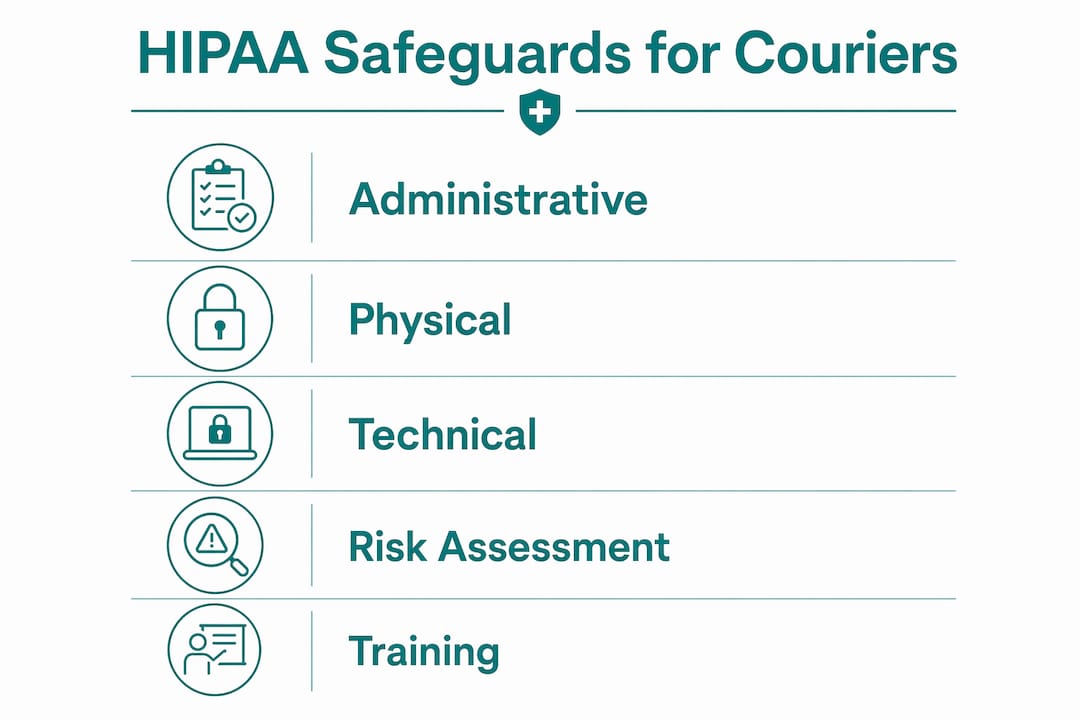
Administrative safeguards form the policy backbone of HIPAA compliance for couriers. They include annual workforce training, documented risk assessments, and written incident response plans. Role-based, scenario-based training is the standard, meaning a driver who handles specimens needs different training content than a dispatcher who manages digital manifests. Training must be documented, dated, and retained as evidence of compliance.
Risk assessments identify where PHI is most vulnerable in your operation. For couriers, high-risk points typically include vehicle handoffs, paper manifests left in unsecured cabs, and verbal communication of patient details over unencrypted phone lines. A written incident response plan tells your team exactly what to do when a breach occurs, including who to notify and within what timeframe.
Physical safeguards
Physical safeguards protect PHI during transport and handling. Locked containers, tamper-evident seals, secure vehicles, and controlled-access handling facilities are all required elements. A specimen left in an unlocked vehicle, even briefly, constitutes a potential HIPAA violation. The same applies to paper records visible through a vehicle window.
Tamper-evident packaging serves two purposes. It protects the physical integrity of the specimen or record, and it creates a visible indicator of unauthorized access. Compliance officers should audit physical safeguards during route inspections, not just during annual reviews.
Technical safeguards
Technical safeguards govern electronic PHI. Data encryption is mandatory for any electronic PHI used in courier manifest systems or communications. Sending a patient name and delivery address via standard SMS or unencrypted email is a direct HIPAA violation. Courier platforms must use encrypted channels for all PHI transmission.
Chain-of-custody logs are a technical requirement with specific retention rules. HIPAA mandates that these logs record who handled a package, what it contained, when each transfer occurred, where it moved, and how it was secured. These audit trails must be retained for at least six years and must be tamper-proof.
| Safeguard category | Key requirement | Common failure |
|---|---|---|
| Administrative | Annual documented training | No role-specific content |
| Physical | Locked containers, tamper-evident seals | PHI visible in unsecured vehicles |
| Technical | Encrypted manifests and communications | Unencrypted SMS or email with PHI |
| Documentation | Chain-of-custody logs for six years | Incomplete or alterable records |
Pro Tip: Audit your digital manifest platform specifically for tamper-proof logging. If a dispatcher can edit a delivery record after the fact without a visible change history, your audit trail will not hold up under OCR scrutiny.
How does the minimum necessary standard affect courier operations?
The minimum necessary standard, defined under 45 CFR §164.502(b), requires that PHI exposure be limited to the least amount necessary to accomplish the task. For medical couriers, this principle directly shapes what information appears on delivery manifests and chain-of-custody documents.
A compliant delivery manifest includes a patient ID number and a destination address. It does not include a diagnosis, a medication name, or a clinical note. Delivery manifests should contain only essential information such as patient ID and destination, with no diagnostic or clinical detail. That distinction matters because a lost manifest with a patient ID is a far smaller breach risk than one listing a patient's HIV status and home address.
Compliance officers should review manifest templates against the minimum necessary standard annually. The following practices align with this standard:
- Using numeric patient identifiers instead of full names on external labels
- Restricting dispatcher access to clinical details that are not needed for routing
- Removing diagnostic codes from any document that leaves a secure facility
- Training drivers to refuse verbal PHI they do not need to complete the delivery
- Logging only the data fields required for chain-of-custody accountability
The minimum necessary standard also applies to internal communications. A driver does not need to know why a specimen is urgent, only that it requires expedited handling. Limiting PHI exposure at every touchpoint reduces your breach surface and your liability.
What are the best practices and common pitfalls for HIPAA-compliant courier services?
HIPAA compliance for medical couriers is an ongoing operational standard, not a one-time certification. The most common pitfall is treating a training course completion as proof of compliance. HIPAA certification means ongoing documented staff training, procedural adherence, and scenario-based preparation across your entire workforce.
The second most common pitfall is false reliance on the conduit exception. Logistics companies that log patient names, use delivery software with PHI fields, or receive clinical context for deliveries are Business Associates by definition. Operational PHI workflows categorically require BAAs and full HIPAA compliance. Assuming otherwise exposes your organization to penalties that could exceed your annual revenue.
Practical best practices for maintaining compliance include:
- Signing BAAs with every covered entity before the first PHI handoff
- Conducting annual risk assessments with written findings and remediation plans
- Using HIPAA-aware courier workflows that limit PHI fields in digital platforms
- Retaining chain-of-custody logs for six years in a tamper-proof system
- Reporting suspected breaches to your covered entity partner within 60 days
- Reviewing and updating incident response plans after any near-miss event
Breach reporting deserves specific attention. The 60-day notification window under the HIPAA Breach Notification Rule begins when you discover the breach, not when you confirm it. Waiting for certainty before reporting is a compliance error. Notify your covered entity contact as soon as a breach is suspected, then investigate.
Pro Tip: Schedule a tabletop exercise twice a year where your team walks through a simulated PHI breach scenario. Written policies mean nothing if your staff freezes when a package goes missing.
Key Takeaways
Medical couriers are HIPAA Business Associates and must sign BAAs, apply three categories of safeguards, and retain tamper-proof chain-of-custody logs for six years to remain compliant.
| Point | Details |
|---|---|
| Business Associate status | Couriers with operational PHI access must sign BAAs before handling any patient data. |
| Conduit exception does not apply | Logging patient names or using delivery software with PHI fields triggers full HIPAA obligations. |
| Three safeguard categories | Administrative, physical, and technical safeguards each address distinct compliance risks. |
| Minimum necessary standard | Delivery manifests should contain only patient ID and destination, never clinical details. |
| Compliance is ongoing | Annual training, risk assessments, and tamper-proof audit logs are required, not optional. |
What I've learned watching courier compliance fail in the field
I've reviewed a lot of courier operations over the years, and the pattern that concerns me most is not malicious. It's complacency. Teams that handle specimens every day start treating PHI like ordinary cargo. The urgency fades. The locked container gets left open "just for a minute." The manifest gets texted to a driver because it's faster.
The conduit exception is the single most misused concept in healthcare logistics. I've spoken with operations managers who genuinely believed their courier service was exempt from HIPAA because they "just transport things." That belief is wrong, and it's expensive when the OCR comes knocking. The moment your software logs a patient identifier, you are a Business Associate. Full stop.
What actually works is building compliance into the physical workflow, not just the training manual. Tamper-evident packaging should be standard issue, not an option. Encrypted dispatch platforms should be the only option for communicating PHI. And chain-of-custody logs should be reviewed by a compliance officer quarterly, not just pulled during an audit.
The couriers who get this right treat HIPAA compliance the same way they treat vehicle maintenance. It's not a project. It's a recurring operational standard with real consequences when skipped. Technology helps, but culture is what sustains it. If your drivers know why PHI protection matters to patients, they handle it differently.
> — Copergrine Editorial Team
***
Copergrine's approach to HIPAA-compliant medical courier operations
Copergrine builds HIPAA compliance into every layer of its medical courier service, from signed Business Associate Agreements to encrypted dispatch communications and tamper-evident packaging protocols. The operation covers the Greater Houston area with real-time tracking and documented chain-of-custody logs that meet the six-year retention standard.

For healthcare providers and compliance officers who need a courier partner with documented safeguards and a clear BAA process, Copergrine's medical courier service in Dallas and Houston operations are built to meet those requirements. Copergrine also integrates courier logistics with its EMR platform, giving practices a single system for managing clinical data and delivery accountability without creating new PHI exposure points.
***
FAQ
What makes a medical courier a HIPAA Business Associate?
A medical courier becomes a Business Associate under HIPAA when it operationally accesses PHI, such as logging patient names, scanning specimen labels, or using delivery software with patient data fields. This classification requires a signed BAA before any PHI handling begins.
Does the conduit exception apply to medical couriers?
The conduit exception does not apply to medical couriers that use operational workflows involving PHI. The exception covers entities like postal services that move data without any ability to read or use it. Couriers that log patient identifiers or use clinical delivery software are Business Associates by law.
What must a Business Associate Agreement cover for a courier?
A BAA for a medical courier must specify permitted PHI uses, outline the courier's safeguard obligations, and require breach notification to the covered entity within 60 days of discovery.
How long must medical couriers retain chain-of-custody logs?
HIPAA requires chain-of-custody logs to be retained for at least six years. These records must document who handled each package, when each transfer occurred, and how the PHI was secured at every point.
What is the minimum necessary standard for courier manifests?
The minimum necessary standard limits delivery manifests to essential information such as a patient ID number and destination address. Diagnostic codes, medication names, and clinical notes must not appear on any courier document that could be lost or accessed by unauthorized parties.
Recommended
- How HIPAA-aware courier workflows protect patient samples | Copergrine
- What Is a Medical Courier Service? A Clear Guide | Copergrine
- Medical courier for hospitals, labs, and the VA: compliance-ready logistics at scale | Copergrine
- What practices and clinics should expect from a dedicated medical courier partner | Copergrine