
Route Optimization for Couriers: A 2026 Operations Guide
Discover what route optimization means for couriers in 2026. Maximize efficiency, reduce costs, and enhance delivery performance today!

Route Optimization for Couriers: A 2026 Operations Guide
***
> TL;DR: > > - Route optimization calculates the most efficient delivery stop sequence using algorithms that consider real-world constraints. It reduces fuel costs by 15 to 30 percent and increases vehicle capacity by up to 20 percent, improving overall efficiency. Dynamic re-optimization handles traffic and last-minute changes, enabling courier fleets to adapt in real time and maintain high on-time performance.
***
Route optimization for couriers is defined as the mathematical process of calculating the most efficient sequence of delivery stops for a vehicle fleet, accounting for real-world constraints like time windows, vehicle capacity, and live traffic conditions. Understanding what route optimization means for couriers goes beyond finding the shortest path. It means balancing distance, fuel consumption, driver hours, and customer commitments simultaneously. Last-mile delivery costs represent about 53% of total shipping expenses, making this discipline one of the highest-leverage areas in courier operations. Logistics managers who treat route planning as a secondary task pay a measurable price in fuel, overtime, and lost customers.
What does route optimization mean for couriers in practice?
Route optimization, formally known in logistics as solving the Vehicle Routing Problem (VRP), is the computational challenge of assigning stops to vehicles and sequencing those stops for maximum efficiency. The VRP is not a simple calculation. It requires software to evaluate thousands of possible combinations while respecting hard constraints like delivery windows, driver shift limits, and vehicle load capacities.
Manual planning cannot handle this complexity reliably. Route optimization complexity grows factorially with stop count, meaning a fleet with just 10 stops faces over 3.6 million possible sequences. A dispatcher working from a map and experience will never evaluate more than a fraction of those options. Software algorithms, by contrast, evaluate all viable combinations and return the most cost-effective solution in seconds.
Real-time re-optimization adds another layer of value. Static route planning fails to address real-time changes, while modern systems respond dynamically to traffic incidents, last-minute cancellations, and urgent pickup requests. This adaptability is what separates a functional routing tool from a genuinely effective one.
Pro Tip: When evaluating routing software, test its re-optimization speed under simulated disruptions. A system that takes more than two minutes to recalculate a disrupted route will slow your dispatchers during the moments they need speed most.
The core constraints that any courier route optimization system must handle include:
- Delivery time windows: Customer-specified windows that cannot be missed without service failure
- Vehicle load limits: Weight and volume caps that determine how many stops each vehicle can serve
- Driver hours: Regulatory and contractual limits on shift length and driving time
- Traffic patterns: Historical and live data that affect travel time between stops
- Service time at stops: The time a driver spends at each location, which affects total route duration
What are the key benefits of route optimization for courier services?
The financial case for route optimization is direct and well-documented. Route optimization typically produces a 15–30% reduction in total distance and fuel costs compared to manually planned routes. For a fleet running daily deliveries across a metro area, that reduction compounds quickly into significant monthly savings.
Capacity gains are equally compelling. Optimizing delivery routes commonly increases vehicle delivery capacity by 15–20% without adding drivers or extending shift hours. That means more stops served per vehicle per day, which directly improves revenue per driver without increasing headcount costs.
Labor savings can be concrete and measurable. A fleet using route optimization software can reduce weekly overtime and its associated labor costs. Those savings come from tighter routes that finish on time rather than running long into overtime.
Service quality improves alongside cost metrics. Optimized routes reduce backtracking, waiting, and driving in congested zones, which tightens delivery windows and raises on-time performance. Higher on-time rates directly support customer retention, and businesses delaying route optimization pay an inefficiency tax as late deliveries erode customer loyalty over time.
Environmental performance also improves. Fewer miles driven means lower fuel consumption and reduced carbon emissions per delivery. For courier services operating under sustainability commitments or reporting to clients with carbon targets, this is a measurable and reportable gain.
What challenges should logistics managers expect with route optimization?
Route optimization is not a plug-and-play solution. The complexity of real-world courier operations creates implementation challenges that logistics managers must plan for before selecting and deploying any system.
The most common pitfall is treating route optimization as purely a shortest-path problem. Route optimization requires balancing distance, fuel, and driver time simultaneously, and ignoring any one of these variables produces fragile routes that break under real conditions. A route optimized only for distance may violate driver hour limits. A route optimized only for speed may overload vehicles or miss time windows.
Dynamic conditions create a second layer of challenge. Traffic incidents, weather, and urgent pickups all change the optimal route mid-shift. Fleets relying on static morning plans will absorb these disruptions as delays and missed windows rather than adapting in real time. The difference between static and dynamic planning is the difference between a plan that works at 8 a.m. and one that still works at 2 p.m.
Other operational factors that require careful configuration include:
- Strict delivery time windows: Medical and pharmaceutical couriers, in particular, face windows measured in minutes rather than hours
- Driver hour regulations: Department of Transportation hours-of-service rules must be embedded in route constraints, not managed separately
- Vehicle-specific capabilities: Refrigerated vehicles, load-bearing limits, and access restrictions all affect which stops each vehicle can serve
- Customer-specific requirements: Some stops require specific drivers, equipment, or credentials that the system must respect
Pro Tip: Integrate your route optimization platform with your inventory and supply planning systems before go-live. Top route optimization today connects with supply and inventory planning to produce routes that reflect actual load availability, not just scheduled stops.
How does manual planning compare to algorithmic route optimization?
The performance gap between manual and algorithmic planning is large enough to affect competitive position, not just operational efficiency. Manual route planning for a 10-driver fleet typically requires 60–90 minutes of dispatcher time each morning. Software reduces daily planning time to 5–15 minutes, freeing dispatchers to manage exceptions, communicate with drivers, and handle customer escalations instead of building spreadsheets.
The quality gap is equally significant. Manual plans tend to produce routes with 20–40% more mileage than algorithmically optimized equivalents, because human planners cannot evaluate the full solution space. That excess mileage translates directly into higher fuel costs, more driver hours, and greater vehicle wear.
| Planning dimension | Manual planning | Algorithmic optimization |
|---|---|---|
| Daily planning time | 60–90 minutes | 5–15 minutes |
| Route efficiency | 20–40% excess mileage typical | Minimized distance and fuel |
| Real-time adaptability | Limited, requires manual rework | Dynamic re-optimization mid-shift |
| Scalability | Degrades as fleet size grows | Handles large fleets consistently |
| Constraint handling | Relies on dispatcher memory | Enforces all constraints automatically |
Scalability is where the gap widens most sharply. A dispatcher can manage a 5-vehicle fleet manually with reasonable results. At 20 or 50 vehicles, manual planning becomes the operational bottleneck. Algorithmic systems handle larger fleets without proportional increases in planning time or error rates.
For courier services operating on-demand delivery models, the ability to re-optimize routes in real time is not optional. It is the core capability that makes same-day and urgent delivery commitments achievable at scale.
How to implement route optimization in courier operations
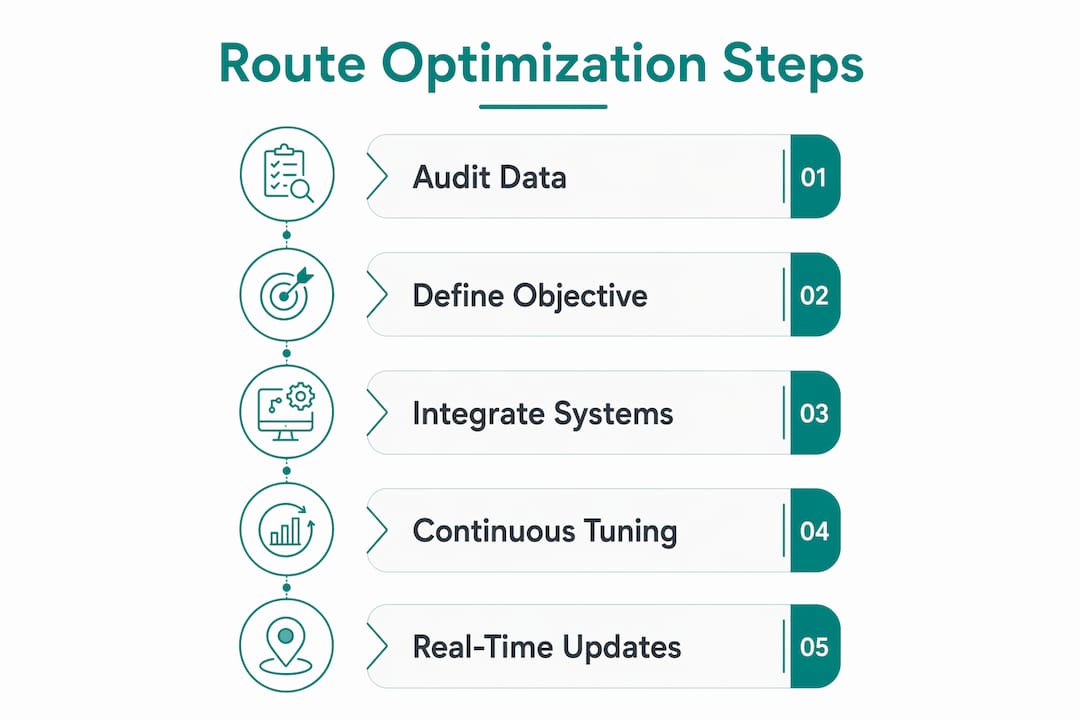
Successful implementation follows a clear sequence. Rushing any step creates configuration problems that undermine the system's output quality.
Start by auditing your current delivery data. Measure average stop counts per route, current mileage per vehicle, on-time delivery rates, and overtime frequency. These baseline metrics define your starting point and give you the benchmarks to measure improvement against after go-live.
Next, define your optimization objective clearly. Cost minimization, time minimization, and capacity maximization produce different route outputs. A medical courier service prioritizing on-time delivery for specimen transport will configure its system differently than a parcel fleet prioritizing fuel cost reduction. Aligning the objective with your business model is a configuration decision, not a software default.
Integration with dispatch and fleet management systems is the technical step most teams underestimate. Route optimization software produces value only when its output flows directly into driver dispatch, not when dispatchers must manually transfer route data between systems. Build the integration before training staff on the new workflow.
Staff training should cover both the software interface and the new decision-making process. Dispatchers accustomed to manual planning will initially distrust algorithmic outputs. Address this by running parallel plans for the first two weeks, showing dispatchers where the algorithm outperforms their manual routes on measurable metrics.
Post-implementation, track these key performance indicators weekly:
- Miles per delivery stop
- On-time delivery rate
- Overtime hours per driver per week
- Fuel cost per route
- Daily planning time per dispatcher
Monitoring these metrics consistently reveals whether the system is configured correctly and where further tuning is needed. For courier services handling sensitive deliveries, dispatch quality remains a parallel factor that route software alone cannot replace.
Key Takeaways
Route optimization for couriers is the single most impactful operational lever for reducing fuel costs, overtime, and missed delivery windows across a delivery fleet.
| Point | Details |
|---|---|
| Core definition | Route optimization calculates the most efficient stop sequence using algorithms, not shortest-path guesswork. |
| Financial impact | Optimized routes cut total distance and fuel costs by 15–30% and reduce overtime measurably. |
| Capacity gains | Fleets gain 15–20% more delivery capacity per vehicle without adding drivers or hours. |
| Manual planning gap | Manual planning produces 20–40% excess mileage and takes 60–90 minutes daily versus 5–15 with software. |
| Dynamic re-optimization | Real-time re-routing handles traffic, cancellations, and urgent pickups that static plans cannot address. |
Route optimization is a foundation, not a feature
Route optimization is not a technology upgrade. It is a foundational operational capability, and logistics managers who treat it as optional are accepting a structural cost disadvantage.
The insight most managers miss is that the value of optimization compounds over time. The first month of implementation shows fuel and overtime savings. The second and third months reveal capacity gains as drivers complete more stops per shift. By month six, the planning culture shifts. Dispatchers stop thinking in terms of "good enough" routes and start expecting the system to surface the best available option automatically.
The mistake I see most often is implementing optimization software without connecting it to dispatch workflows. The algorithm produces an excellent route, and then a dispatcher manually re-sequences stops based on habit or preference, erasing the efficiency gains before a single driver leaves the depot. Integration is not optional. It is the mechanism that converts software output into operational results.
Dynamic re-optimization is the capability that separates high-performing fleets from average ones. A morning plan is a starting point. What happens between 9 a.m. and 4 p.m., including traffic, missed pickups, and urgent additions, determines whether the fleet actually performs at the level the algorithm projected. Fleets without real-time re-routing absorb those disruptions as cost. Fleets with it convert them into managed adjustments.
The next frontier is integration with AI-driven inventory and supply chain systems. Routes that reflect actual load availability, not just scheduled stops, eliminate a significant source of re-planning mid-shift. That integration is available now in enterprise-grade platforms and will become standard across mid-market tools within the next two years.
> — Copergrine Editorial Team
***
Copergrine's approach to courier efficiency in healthcare logistics
Copergrine operates a medical courier service across the Greater Houston area with a direct focus on delivery reliability and speed for clinical and patient-facing logistics. The service is built around real-time tracking and rapid response times, applying the same efficiency principles that route optimization research validates across the broader courier industry.
For healthcare providers and logistics managers evaluating courier partners, Copergrine's medical courier service integrates dispatch precision with route efficiency to meet the strict time windows that clinical deliveries require. Whether the need is specimen transport, pharmaceutical delivery, or STAT runs, Copergrine's operations are structured around the same constraints that define high-performance route optimization: time windows, vehicle capacity, and real-time adaptability. Contact Copergrine to discuss how its courier logistics model fits your operational requirements.
***
FAQ
What does route optimization mean for couriers?
Route optimization for couriers is the process of calculating the most efficient sequence of delivery stops for a vehicle fleet, using algorithms that account for time windows, vehicle capacity, traffic, and driver hours. It goes beyond shortest-path calculation to balance multiple cost factors simultaneously.
How much can route optimization reduce courier costs?
Route optimization typically reduces total distance and fuel costs by 15–30% compared to manually planned routes, with additional savings from reduced overtime and increased delivery capacity per vehicle.
What is the Vehicle Routing Problem in courier logistics?
The Vehicle Routing Problem (VRP) is the mathematical framework that route optimization software solves. It determines how to assign stops to vehicles and sequence those stops to minimize total cost while respecting all operational constraints.
How long does route planning take with optimization software?
Software reduces daily route planning from 60–90 minutes to 5–15 minutes for a 10-driver fleet, freeing dispatchers to manage exceptions and customer communications instead of building manual plans.
Why does dynamic re-optimization matter for courier fleets?
Static morning plans cannot account for traffic incidents, cancellations, or urgent pickups that occur during a shift. Dynamic re-optimization adjusts routes in real time, maintaining efficiency and on-time performance throughout the delivery day rather than only at the start.
Recommended
- What Is On-Demand Courier Service: A Clear Guide | Copergrine
- Why dispatch matters more than the route in medical delivery | Copergrine
- Medical courier for hospitals, labs, and the VA: compliance-ready logistics at scale | Copergrine
- How to evaluate a medical courier's reliability before you commit | Copergrine