
How to Set Up a Recurring Courier Contract for Medical Supplies
Learn how to set up a recurring courier contract for medical supplies. Ensure reliable delivery and compliance with essential standards.

How to Set Up a Recurring Courier Contract for Medical Supplies
***
> TL;DR: > > - Recurring courier contracts establish scheduled, ongoing delivery commitments that are essential for healthcare operations handling sensitive supplies. > - Proper setup involves documenting operational needs, defining specific performance standards, and incorporating detailed legal and logistical provisions to prevent failures. > - Regular performance monitoring and clear contractual language ensure reliability and compliance, helping healthcare providers maintain patient safety and supply chain integrity.
***
A recurring courier contract is a formal, scheduled delivery agreement between a business and a courier provider that governs repeated pickups and deliveries under defined service terms. For healthcare operations, this type of long-term courier agreement is not optional. Medical supplies, specimens, and pharmaceuticals require consistent handling, verified chain of custody, and compliance with HIPAA and temperature-control standards. A well-structured contract protects your operation from service failures, liability gaps, and regulatory exposure. Getting the setup right from the start determines whether your delivery program holds up under real-world pressure.
How to set up a recurring courier contract: prerequisites first
Before you negotiate a single term, you need a clear picture of your operational requirements. Skipping this step produces contracts that look complete on paper but fail in practice.

Start by documenting your delivery volume and frequency. Determine whether you need a weekly courier service, a daily route, or a monthly delivery arrangement with on-demand surge capacity. Medical operations often require both scheduled runs and rapid-response pickups. Rapid-response pickups within 60 minutes are a standard inclusion in high-level B2B medical courier contracts. That standard matters because a contract that only covers scheduled runs leaves urgent needs unaddressed.
Medical courier contracts require specialized handling, temperature-controlled vehicles, and verified courier certifications beyond what standard courier agreements demand. This means you must identify which of your shipments fall under cold-chain requirements, which involve biohazardous specimens, and which require STAT delivery windows. Each category carries different vehicle, driver, and documentation requirements.
The table below summarizes the key information to gather before engaging a courier provider.
| Category | Required information |
|---|---|
| Operational | Delivery frequency, route locations, volume per run, pickup windows |
| Medical/regulatory | Temperature ranges, specimen handling protocols, HIPAA compliance needs |
| Vehicle and driver | Vehicle type (refrigerated, standard), driver certifications, background checks |
| Legal and insurance | Liability limits, insurance minimums, proof-of-delivery requirements |
| Internal management | Contract owner, billing contact, escalation point of contact |
Completing this table before any courier conversation keeps negotiations focused and prevents critical gaps from appearing after the contract is signed.
Pro Tip: Review your HIPAA-aware courier workflows before finalizing your requirements list. Regulatory gaps discovered after contract signing are far more expensive to fix than those caught during planning.
How do you structure and negotiate key contract terms?
The structure of a recurring delivery services contract determines how well it performs when things go wrong. Strong contracts define expectations precisely. Weak contracts defer to goodwill.
Service-level agreements (SLAs) are the foundation. Define on-time delivery rates, maximum response times for urgent pickups, and acceptable damage rates. These are not aspirational targets. They are enforceable benchmarks with financial consequences for non-performance. Written contracts allow negotiating liability caps, performance credits, and escalation steps that emails or standard terms simply cannot provide. This matters most when a missed delivery affects patient care.
Pricing structure is the second critical element. Monthly route contracts for professional B2B delivery typically cost $1,500 to $5,000 depending on volume, frequency, and vehicle requirements. Flat-fee pricing offers budget predictability for recurring routes, while per-delivery fees suit variable volume. For most medical operations, a flat-fee base with a defined volume tier and an overage rate gives the best balance of cost control and flexibility.
The following contract elements require explicit language, not general references:
- Electronic proof of delivery (ePOD): Specify the format, timing, and storage requirements for delivery confirmation records.
- Liability and insurance: Define the courier's maximum liability per shipment and require certificates of insurance naming your organization.
- Claims procedures: State the filing window, required documentation, and resolution timeline for lost or damaged shipments.
- Cancellation and renewal terms: Include notice periods, auto-renewal clauses, and conditions for early termination without penalty.
- Escalation procedures: Define the contact hierarchy and response time for service failures before they become disputes.
Robust courier agreements explicitly cover electronic proof-of-delivery, liability caps, and claim procedures to enforce expectations and reduce disputes. Vague language in any of these areas creates ambiguity that favors the courier, not your operation.
Pro Tip: Selecting a courier based solely on lowest price risks operational failure. Evaluate SLA adherence history and peak-load capacity before signing. A provider that performs well on slow days but fails during high-volume periods is a liability, not an asset.
What operational setup supports a successful recurring contract?
Signing the contract is the beginning, not the end. The operational setup that follows determines whether the agreement delivers its intended value.
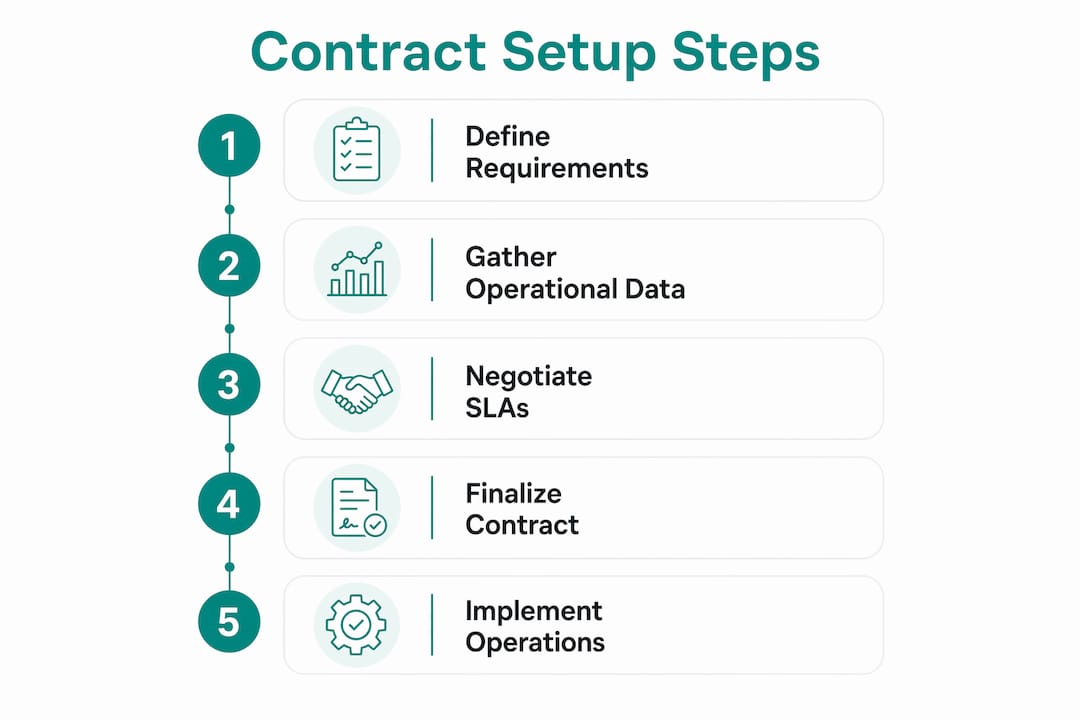
A structured setup for recurring medical courier contracts involves four phases: mapping routes, selecting specialized vehicles, finalizing digital manifests, and agreeing on flat-fee billing. These four phases typically occur before starting operations to establish reliability from day one. Skipping any phase creates gaps that surface as service failures within the first 90 days.
The operational implementation process follows a clear sequence:
- Map routes and sequence stops. Prioritize stops by delivery urgency, not geographic convenience. STAT specimens and temperature-sensitive shipments take priority over standard supply runs.
- Assign specialized vehicles. Match vehicle type to shipment requirements. Temperature-controlled vehicles are non-negotiable for cold-chain items. Confirm vehicle certifications match your contract specifications.
- Set up electronic manifests. Digital manifests create an auditable record for every pickup and delivery. They also support HIPAA compliance by documenting chain of custody without paper-based gaps.
- Integrate GPS and telematics. Real-time tracking allows your team to monitor on-time performance and receive alerts for delays before they affect patients. Copergrine's medical courier service uses real-time tracking as a standard feature, not an add-on.
- Establish a KPI review cadence. Schedule monthly reviews of on-time rates, damage incidents, and cost-per-shipment. Monthly KPI tracking for on-time rates, damage, and cost-per-shipment prevents service degradation from going undetected.
- Train drivers and staff. Healthcare delivery standards differ from standard logistics. Drivers must understand specimen handling, temperature logging, and HIPAA-compliant documentation before their first run.
Pro Tip: Ask your courier provider for a sample digital manifest before signing. If they cannot produce one, their documentation process is likely manual. Manual processes introduce errors that create compliance exposure in medical delivery environments.
How do you avoid common mistakes in courier contract management?
Most recurring courier contract failures trace back to decisions made before the first delivery, not after. Knowing the common pitfalls lets you design around them.
Ambiguous contract language is the most frequent problem. Terms like "timely delivery" or "reasonable care" have no enforceable meaning. Every performance expectation needs a number attached to it. Clear, detailed B2B service agreements are critical to managing liability, insurance, and service guarantees. Standard terms and conditions are not sufficient for ongoing medical logistics contracts.
Volume forecasting errors create a different category of risk. Underestimating delivery volume leads to capacity shortfalls during peak periods. Overestimating locks you into minimum-spend commitments that exceed actual needs. Build a volume review clause into the contract that allows adjustment every six months without triggering a full renegotiation.
> Formal written contracts are the single most effective tool for managing a recurring courier relationship. Informal agreements, email threads, and verbal commitments cannot be enforced when service quality drops or a dispute arises.
Service failures require a documented response process. When a delivery is missed or a specimen is compromised, your contract should specify the exact steps: notification timeline, credit calculation, corrective action plan, and escalation path if the issue recurs. Without this structure, every failure becomes a negotiation rather than a resolution.
The following mistakes appear most often in medical courier contract management:
- Insufficient SLA detail: On-time rates and response windows must be numeric and measurable.
- No scalability clause: Contracts that cannot accommodate volume growth force renegotiation at the worst possible time.
- Missing liability language: Without defined liability caps, a single damaged shipment can create an open-ended financial dispute.
- Skipping monthly audits: A "set it and forget it" approach to contract management allows hidden costs and service degradation to compound over time.
Pro Tip: Maintain a formal written contract for every courier relationship, regardless of how long you have worked with the provider. Familiarity does not replace legal clarity. Reviewing your contract terms against compliance-ready logistics standards annually keeps your agreement current with regulatory changes.
Key Takeaways
A recurring courier contract for medical supplies succeeds when it combines precise SLA language, verified operational protocols, and active monthly performance monitoring from day one.
| Point | Details |
|---|---|
| Define requirements before negotiating | Document volume, frequency, temperature needs, and certifications before contacting any courier provider. |
| Use flat-fee pricing with volume tiers | Flat-fee structures offer budget predictability; include overage rates for volume flexibility. |
| Require explicit contract language | Every SLA, liability cap, and claims procedure needs specific numbers and timelines, not general terms. |
| Build in operational protocols | Route mapping, digital manifests, and GPS tracking must be active before the first scheduled run. |
| Monitor KPIs monthly | Track on-time rates, damage incidents, and cost-per-shipment to catch service degradation early. |
What I have learned about medical courier contracts that most guides miss
By Copergrine Editorial Team
After working through dozens of medical logistics arrangements, the pattern I see most often is this: organizations spend significant time negotiating price and almost no time defining what happens when the contract underperforms. That imbalance is where most courier relationships eventually break down.
The contracts that hold up are the ones where both parties agreed, in writing, on exactly what a service failure looks like and what happens next. Not in vague terms. In specific ones. A missed pickup within a defined window triggers a credit. Two missed pickups in a month triggers a formal review. Three triggers a termination right. That level of specificity feels excessive until the moment you actually need it.
The second thing most guides underemphasize is the relationship between your internal team and the courier's operations team. A contract is a document. The relationship is what makes it work day to day. Assign a single internal point of contact for courier management. Schedule a brief monthly call with your courier's account manager. Review the KPI data together, not just internally. Providers respond differently when they know their performance is being tracked and discussed openly.
Cost is the last factor to negotiate, not the first. Choosing courier providers based solely on low cost undermines reliability. The providers who win on price alone rarely have the capacity, certifications, or documentation systems that medical delivery requires. Start with capability, then negotiate cost within the range of qualified providers.
For medical operations specifically, the stakes of a failed delivery are not just financial. They affect patient care. That reality should shape every decision in the contract setup process, from the SLA targets you set to the escalation procedures you build in.
> — Copergrine Editorial Team
***
Copergrine's medical courier service for recurring contracts
Healthcare operations in the Greater Houston area that need a dependable recurring delivery partner can work directly with Copergrine's medical courier service. Copergrine operates with real-time GPS tracking, HIPAA-aware documentation protocols, and temperature-controlled logistics designed for clinical environments.

Copergrine supports contract setup with defined SLAs, electronic proof-of-delivery, and compliance-ready processes that meet the standards healthcare providers require. For practices and logistics managers evaluating a dedicated medical courier partner, Copergrine offers the operational structure and regulatory awareness that medical supply delivery demands. Contact Copergrine to discuss a recurring delivery arrangement tailored to your facility's schedule and compliance requirements.
***
FAQ
What is a recurring courier contract?
A recurring courier contract is a formal agreement between a business and a courier provider that schedules repeated deliveries under defined service terms, pricing, and performance standards. It differs from one-off delivery arrangements by establishing ongoing obligations for both parties.
How do I set up a courier service for medical supplies?
Start by documenting your delivery volume, frequency, temperature requirements, and regulatory obligations, then negotiate a contract that includes explicit SLAs, liability caps, and electronic proof-of-delivery requirements. Medical courier contracts require specialized vehicles and verified certifications beyond standard courier agreements.
What should a medical courier contract include?
A medical courier contract must include defined on-time delivery rates, temperature-control specifications, HIPAA compliance obligations, electronic proof-of-delivery protocols, liability caps, claims procedures, and escalation steps for service failures.
How much does a monthly courier contract cost?
Monthly route contracts for B2B delivery typically cost $1,500 to $5,000 depending on volume, frequency, and vehicle requirements. Flat-fee pricing is standard for recurring routes and provides more budget predictability than per-delivery billing.
How often should I review my courier contract performance?
Monthly KPI reviews covering on-time rates, damage incidents, and cost-per-shipment are the standard for active contract management. A "set it and forget it" approach allows service degradation and hidden costs to accumulate undetected.
Recommended
- How to evaluate a medical courier's reliability before you commit | Copergrine
- What practices and clinics should expect from a dedicated medical courier partner | Copergrine
- Medical courier for hospitals, labs, and the VA: compliance-ready logistics at scale | Copergrine
- What Is On-Demand Courier Service: A Clear Guide | Copergrine