
Stat Courier Delivery Explained for Healthcare Professionals
Discover how stat courier delivery works for healthcare. Learn about its importance, benefits, and how it ensures timely transport of critical items.

Stat Courier Delivery Explained for Healthcare Professionals
***
> TL;DR: > > - Stat courier delivery provides immediate, direct transport of critical medical items with continuous tracking to ensure quick delivery. It replaces traditional hub-and-spoke routes with direct routing, maintaining documented chain-of-custody for specimen integrity and regulatory compliance. This service supports faster diagnosis, improved workflow stability, and 24/7 availability for urgent healthcare needs.
***
Stat courier delivery is defined as the immediate, priority transport of critical medical items, dispatched within minutes of a request and tracked continuously until delivery. Unlike standard shipping, a stat delivery service operates 24 hours a day, 7 days a week, 365 days a year, moving blood products, urgent lab specimens, time-sensitive medications, and surgical instruments through direct, point-to-point routes. The term "stat" comes from the Latin statim, meaning immediately, and it remains the recognized clinical standard for urgent logistics in healthcare. Copergrine's medical courier division applies this standard across the Greater Houston area, integrating real-time GPS tracking and documented chain-of-custody protocols into every run.
What is stat courier delivery and how does it differ from regular courier service?
Stat courier delivery is the urgent transportation of critical healthcare items that requires immediate dispatch and continuous tracking to support timely diagnosis and treatment. Regular courier services move packages through hub-and-spoke networks, batching shipments to reduce per-stop costs. Stat delivery skips that network entirely, routing directly from origin to destination with no intermediate stops. That difference in routing is not a minor operational detail. It is the reason a blood specimen reaches the lab in 45 minutes instead of four hours.
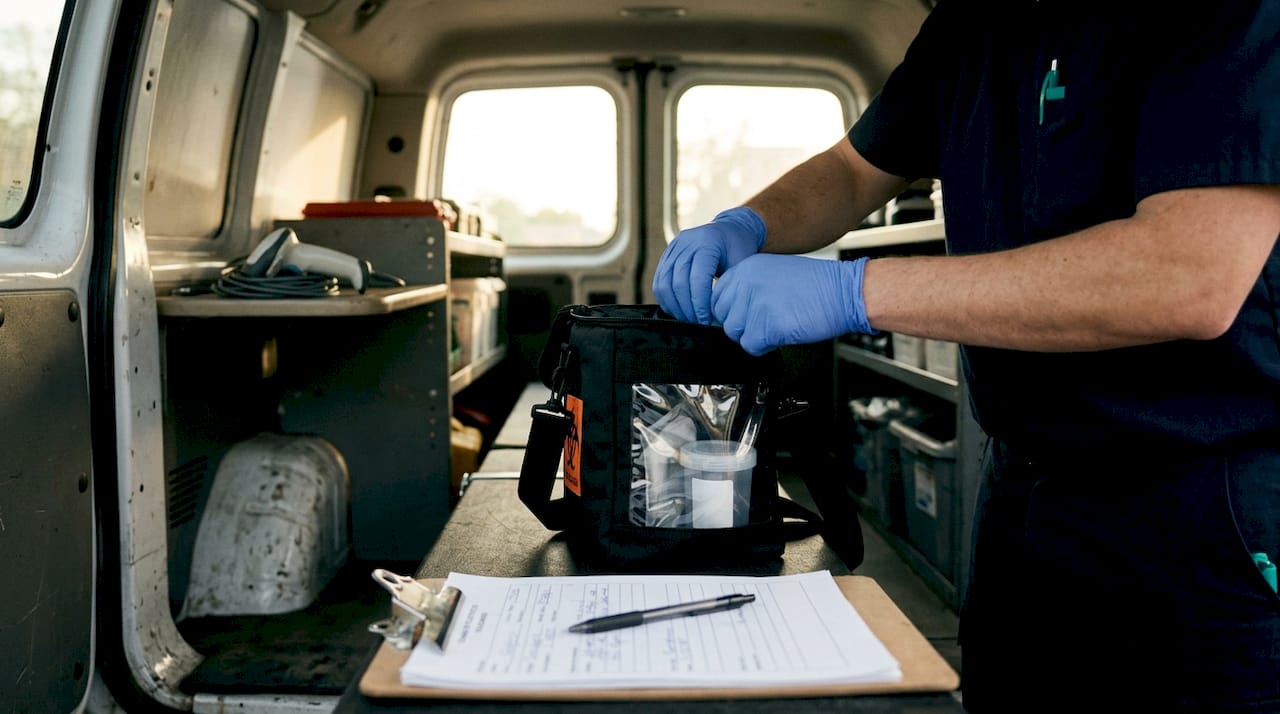
The items transported under a stat protocol carry clinical consequences if delayed. Emergency specimens, urgent blood products, critical medications, and time-sensitive surgical instruments all require the speed and accountability that only a dedicated stat program provides. Standard parcel carriers move packages through hubs, which introduces delays that are acceptable for retail goods but unacceptable for a specimen awaiting a cancer diagnosis. Stat courier delivery removes that uncertainty by design.
Chain-of-custody documentation is another defining feature. Every handoff, from the clinical staff member who packages the specimen to the courier who signs for it, is recorded and timestamped. Biological sample couriers maintain documented custody transfers and temperature controls at every step to protect specimen integrity and regulatory compliance. That level of accountability does not exist in standard shipping.
How does stat courier delivery work? Operational workflow and protocols
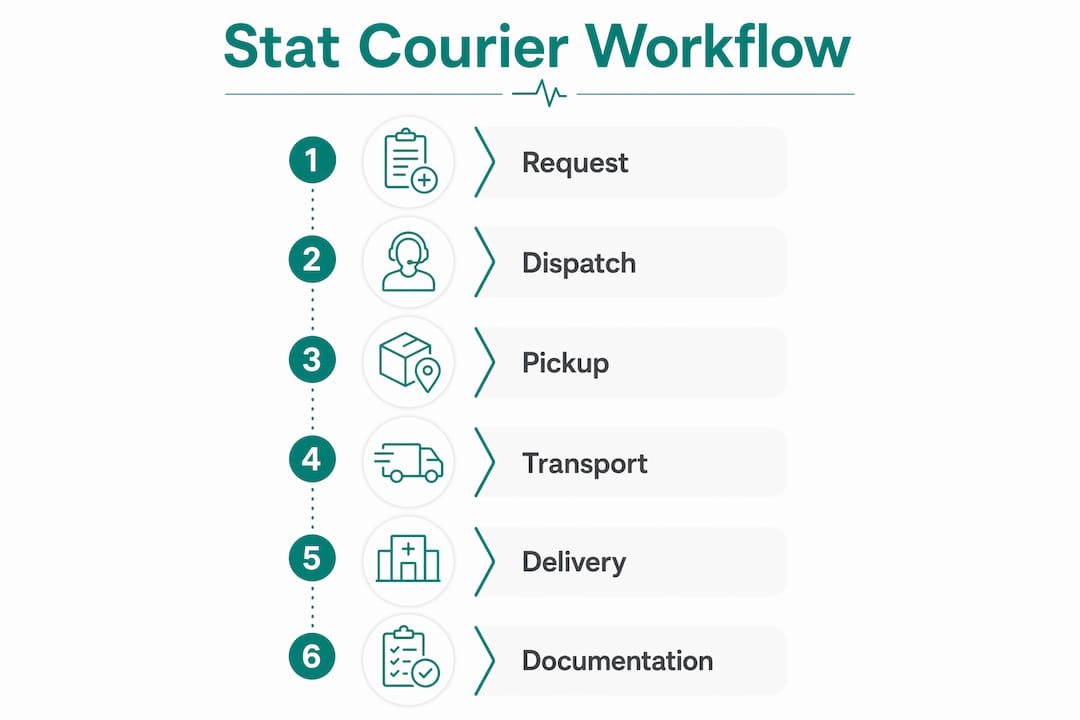
The operational sequence in a stat delivery program follows a defined order, and each step is non-negotiable.
- Request initiation. A healthcare facility, clinic, or individual submits a pickup request, typically by phone or digital dispatch platform. The courier service acknowledges the request and assigns a driver immediately.
- Immediate dispatch. Certified personnel and vehicles deploy within minutes of the request. Drivers are pre-positioned or on standby to minimize response time.
- Pickup and custody transfer. The courier arrives at the origin location, verifies the shipment, and signs for it. A barcode scan at pickup creates the first timestamp in the chain-of-custody record.
- Direct routing. The driver takes the most direct route to the destination. No stops, no batching, no network handoffs. Real-time GPS tracking allows the receiving facility to monitor transit progress and prepare for arrival.
- Delivery and confirmation. The courier delivers the item, obtains a signature, and scans the barcode again. The chain-of-custody record closes, and both parties receive confirmation.
- Integration with lab workflow. The receiving lab knows the specimen is en route before it arrives. That advance notice allows lab staff to prepare equipment and prioritize the incoming sample, reducing total turnaround time.
Pro Tip: Ask your stat courier provider whether their drivers carry redundant coverage, meaning a backup driver is available if the primary driver encounters a delay. Redundant driver coverage is a mark of a mature stat program and protects against gaps during high-volume periods.
What are the benefits of using stat courier delivery in healthcare?
The clinical and operational benefits of a well-run stat courier program extend well beyond speed.
Faster diagnosis and treatment timelines. When a specimen arrives at the lab without delay, the testing cycle begins sooner. Healthcare organizations using stat delivery report reduced escalations, improved visibility, and maintained specimen integrity, all of which contribute to faster diagnosis timelines. For a patient awaiting a critical result, that speed has direct clinical significance.
Stabilized lab workflows. Uncertainty about when a specimen will arrive forces lab staff to stay in a reactive posture. Structured stat programs stabilize lab workflows by removing that uncertainty, allowing staff to focus on testing rather than tracking transit. A predictable specimen arrival schedule is one of the most underappreciated efficiency gains in laboratory operations.
Specimen integrity protection. Temperature-sensitive samples, including certain blood products and tissue specimens, degrade if transit conditions are not controlled. Stat couriers use validated temperature packaging and document conditions throughout the run. That protection is not optional for regulated specimens. It is a compliance requirement.
24/7 availability for emergency needs. Medical emergencies do not follow business hours. A stat courier program that operates around the clock means a facility can request urgent transport at 2:00 AM on a Sunday with the same response time as a Tuesday afternoon. That availability is the foundation of genuine emergency logistics support.
Reduced escalations and missed pickups. Direct dispatch oversight and enforced chain of custody at every step reduce the communication failures that lead to missed pickups and escalation calls. When every handoff is documented and tracked, accountability is built into the process rather than added as an afterthought. You can learn more about how this applies in practice by reviewing urgent specimen pickup protocols for labs.
Stat courier delivery vs. other courier and delivery options
Understanding where stat delivery fits relative to other service types helps healthcare professionals make informed decisions about which option suits each clinical need.
| Feature | Stat courier delivery | Scheduled medical courier | Standard parcel carrier |
|---|---|---|---|
| Dispatch timing | Immediate, on demand | Pre-planned routes and times | Batch pickup windows |
| Routing method | Direct, point-to-point | Optimized multi-stop routes | Hub-and-spoke network |
| Chain of custody | Documented at every handoff | Documented, less granular | Not standard |
| Real-time tracking | Continuous GPS | Route-level updates | Scan-based milestones |
| Temperature control | Validated, specimen-specific | Available, route-dependent | Not standard |
| Cost per delivery | Higher, reflects priority | Lower per stop | Lowest, volume-based |
| Best suited for | Urgent clinical specimens, critical meds | Routine lab transport, scheduled draws | Non-clinical medical supplies |
Scheduled medical courier services offer predictable, planned routes with lower per-stop costs, but they lack the immediacy and routing control of stat delivery. That trade-off is acceptable for routine specimen transport but not for time-critical clinical situations. Standard parcel carriers, meanwhile, move packages through hub networks that introduce delays incompatible with clinical urgency.
The cost difference between stat and scheduled delivery reflects the operational reality of on-demand dispatch. A stat program maintains driver availability, vehicle readiness, and dispatch oversight at all times. That infrastructure costs more per delivery than a scheduled route, and the premium is justified when the clinical stakes are high.
Pro Tip: Use scheduled courier services for routine daily draws and reserve stat delivery for genuinely urgent requests. Mixing the two appropriately controls costs without compromising care. Review how to evaluate courier reliability before committing to any provider.
How to integrate stat courier delivery into your healthcare workflow
Operational alignment before the first stat pickup determines whether the program delivers on its promise. Routes, protocols, and compliance requirements must be defined before the service goes live, not after the first missed handoff.
Define response expectations upfront. Agree on maximum response times for pickup requests, acceptable transit windows, and escalation contacts before the program starts. Vague expectations produce inconsistent results. Written service level agreements protect both the facility and the courier provider.
Align courier protocols with lab and clinical workflows. The courier's arrival time should match the lab's readiness to receive and process. If the courier arrives before the lab has cleared its bench, the efficiency gain disappears. Coordinate pickup schedules with lab supervisors so the two workflows reinforce each other.
Use technology for multi-site operations. Facilities managing stat transport across multiple locations benefit from a centralized dispatch platform that provides visibility into all active runs simultaneously. Real-time tracking data reduces the need for status calls and allows coordinators to identify delays before they become clinical problems.
Train staff on chain-of-custody steps. Clinical staff who package and hand off specimens are part of the chain-of-custody record. They need to understand how to label specimens correctly, what documentation the courier requires at pickup, and how to communicate urgent changes to the dispatch team. A well-trained handoff team reduces errors at the origin point, which is where most custody failures begin.
Establish redundant coverage for high-volume periods. Peak specimen volume periods, such as morning draw rounds, require more driver capacity than off-peak hours. Work with your courier provider to build coverage schedules that match your facility's actual demand pattern. The benefits of same-day lab transport are only realized when coverage matches volume. Federal healthcare contracts, such as those issued by the Department of Veterans Affairs, require trained personnel and vehicle standards that set a useful benchmark for any healthcare organization evaluating a stat courier partner.
Key Takeaways
Stat courier delivery is the most time-critical logistics service in healthcare, defined by immediate dispatch, direct routing, documented chain-of-custody, and 24/7 availability that together protect specimen integrity and accelerate diagnosis timelines.
| Point | Details |
|---|---|
| Immediate dispatch is non-negotiable | Stat couriers deploy certified drivers within minutes of a request, not on a scheduled route. |
| Chain-of-custody protects compliance | Every handoff is documented and timestamped, protecting specimen integrity and regulatory standing. |
| Lab workflow stability improves | Removing specimen arrival uncertainty allows lab staff to focus on testing rather than tracking transit. |
| Cost reflects operational readiness | Higher per-delivery cost covers 24/7 driver availability, vehicle readiness, and continuous dispatch oversight. |
| Pre-launch alignment drives results | Defining protocols, response times, and staff training before the first pickup determines program success. |
Why stat courier delivery deserves more operational attention than it gets
By Copergrine Editorial Team
Most healthcare organizations treat stat courier delivery as a vendor relationship rather than a clinical workflow component. That framing is the source of most stat program failures I have observed. When a facility selects a courier based on price alone and skips the protocol alignment work, the result is a service that is technically "stat" in name but inconsistent in practice.
The misconception I encounter most often is that speed is the only variable that matters. Speed matters, but specimen integrity and chain-of-custody documentation matter just as much. A fast delivery of a compromised specimen produces a result that cannot be trusted. The clinical team then repeats the draw, losing more time than the original delay would have cost.
The future of stat courier delivery points toward tighter integration with EMR systems. When a courier's real-time tracking data feeds directly into a lab information system, the receiving team can prepare for the specimen's arrival with precision. That integration already exists in advanced programs and will become a standard expectation within the next few years. Healthcare teams that build those integrations now will have a measurable operational advantage over those that wait.
My honest recommendation is this: treat your stat courier program as a clinical protocol, not a logistics contract. Define it with the same rigor you apply to specimen handling procedures, and audit it with the same frequency you audit lab quality controls. The payoff is faster diagnoses, fewer escalations, and a lab team that can do its job without interruption.
> — Copergrine Editorial Team
***
Copergrine's stat courier service for urgent healthcare delivery
Copergrine operates a dedicated STAT medical courier service across the Greater Houston area, built specifically for healthcare facilities, labs, and individual patients with urgent transport needs. Every run includes real-time GPS tracking, certified courier personnel, documented chain-of-custody, and temperature-controlled handling for sensitive specimens and medications.

Copergrine's courier division operates 24 hours a day, 7 days a week, with dispatch response times designed for genuine clinical urgency. The service integrates with Copergrine's EMR platform, giving healthcare providers a connected view of logistics and clinical documentation in one system. Healthcare professionals and individuals seeking urgent medical transport in Houston can request service or learn more at Copergrine's courier hub.
***
FAQ
What does "stat" mean in stat courier delivery?
"Stat" comes from the Latin statim, meaning immediately. In healthcare logistics, it designates a delivery that requires immediate dispatch and direct routing with no delays or batching.
What items does a stat courier typically transport?
Stat couriers transport emergency lab specimens, urgent blood products, critical medications, and time-sensitive surgical instruments. All items require speed, temperature control, and documented chain-of-custody handling.
How is stat courier delivery different from scheduled medical courier service?
Scheduled courier services follow pre-planned multi-stop routes with lower per-stop costs, while stat delivery dispatches immediately and routes directly to the destination. Stat delivery costs more per run but is the only appropriate option for time-critical clinical items.
How does chain-of-custody work in a stat delivery?
Chain-of-custody in stat delivery means every handoff is documented with a signature and barcode scan, creating a timestamped record from pickup to delivery. That record protects specimen integrity and satisfies regulatory compliance requirements.
Can individuals, not just healthcare facilities, use stat courier delivery?
Stat courier services are available to both healthcare facilities and individuals with urgent medical transport needs. Copergrine's service, for example, supports individual patients alongside hospitals, clinics, and laboratories across the Greater Houston area.