
The Role of Courier in Home Health Labs: A Complete Guide
Discover the vital role of courier in home health labs. Ensure specimen safety and timely diagnoses with qualified transport professionals.
The Role of Courier in Home Health Labs: A Complete Guide
***
> TL;DR: > > - Medical couriers transport patient specimens securely, maintaining chain of custody and temperature conditions to ensure diagnostic accuracy. Their efficiency and compliance standards directly impact lab turnaround times, specimen integrity, and regulatory adherence in home health settings. Proper training, technology, and quality management practices are essential for reliable specimen transport and accurate results.
***
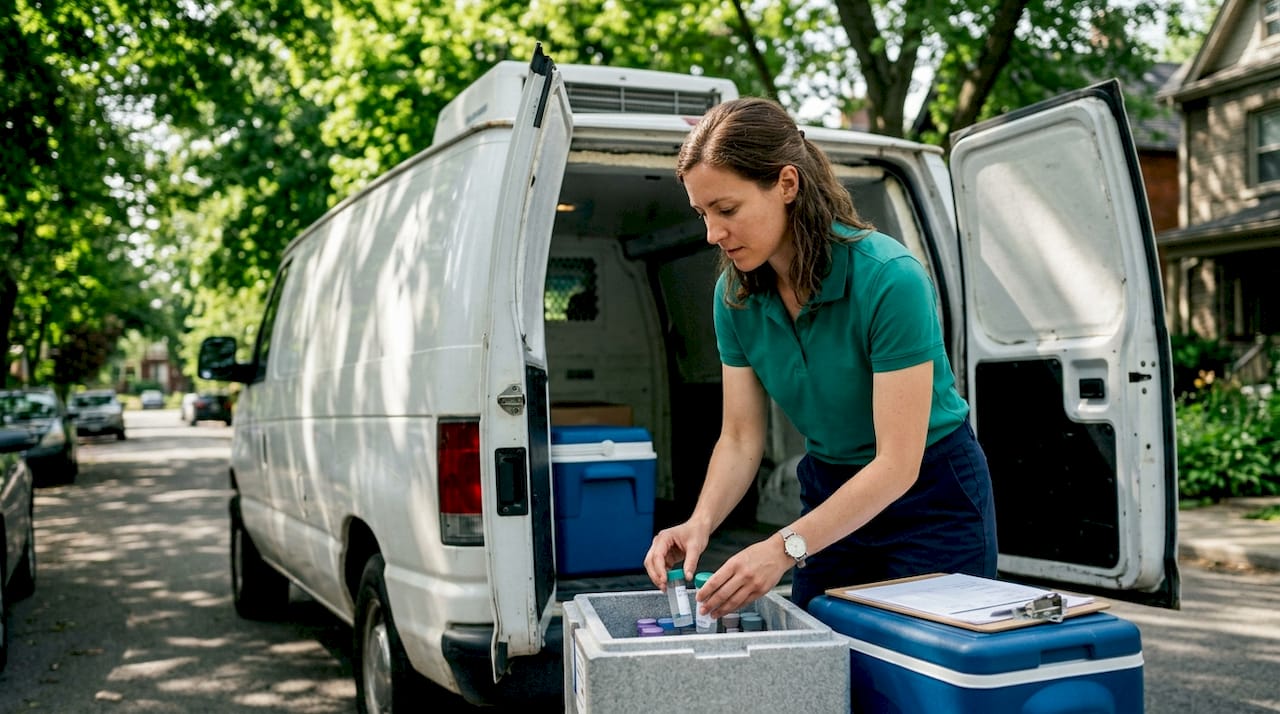
Medical couriers are defined as trained transport professionals who move biological specimens, pharmaceuticals, and diagnostic materials between home health settings and clinical laboratories. The role of courier in home health labs extends well beyond pickup and delivery. Couriers maintain chain of custody, regulate temperature conditions, and support the pre-analytical phase that determines whether a specimen arrives viable or rejected. Lab administrators and healthcare providers who treat this function as a commodity risk specimen degradation, delayed diagnoses, and regulatory exposure. Understanding what a qualified courier actually does, and what standards they must meet, is the foundation of any reliable home health lab program.
What are the key responsibilities of couriers in home health lab specimen transport?
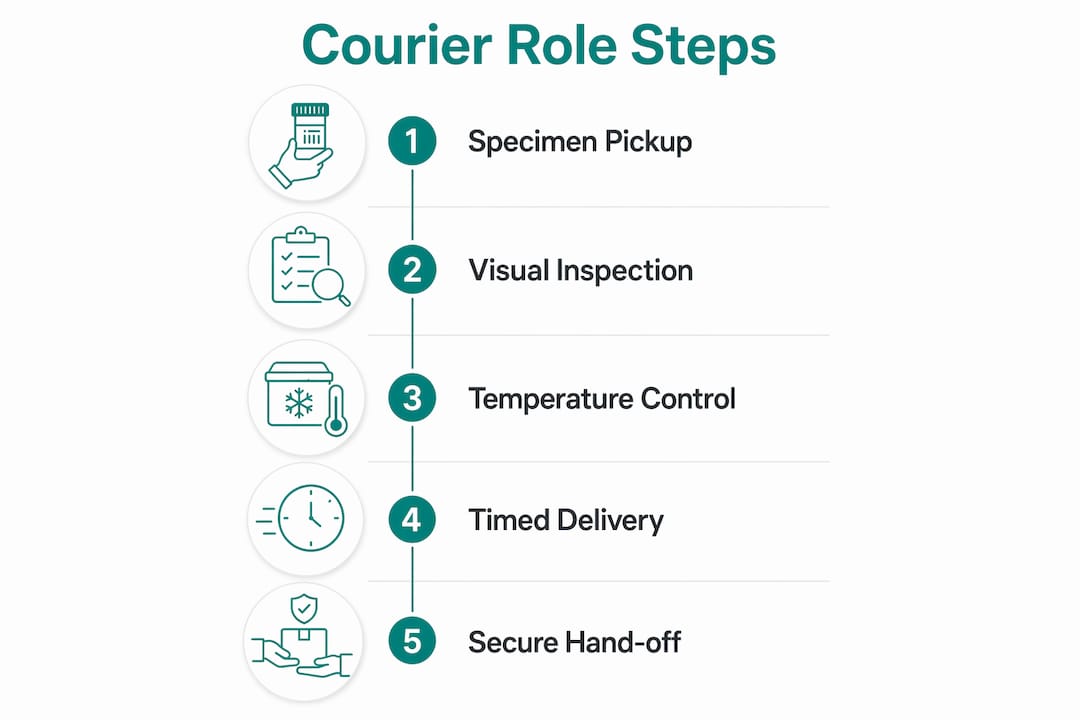
Medical couriers transport specimens between home health settings, clinics, and laboratories, ensuring secure and timely delivery at every step. That definition, while accurate, understates the operational complexity involved. A courier working in home health labs manages a set of responsibilities that directly affect diagnostic outcomes.
The core duties include:
- Scheduled and on-demand pickups: Couriers follow recurring pickup windows at patient homes and satellite clinics, while remaining available for STAT requests that require same-day or urgent transport.
- Cold chain management: Temperature-sensitive specimens, including blood cultures, hormone panels, and certain pathology samples, require insulated carriers, ice packs, or dry ice maintained within specific ranges throughout transit.
- Documentation and chain of custody: Each specimen must be logged at pickup, tracked in transit, and confirmed at delivery. Electronic chain-of-custody (eCOC) systems replace paper logs and provide real-time visibility to lab staff.
- Coordination with lab information systems: Couriers working with labs that use LIS platforms must scan barcodes, confirm specimen IDs, and flag discrepancies before leaving the collection site.
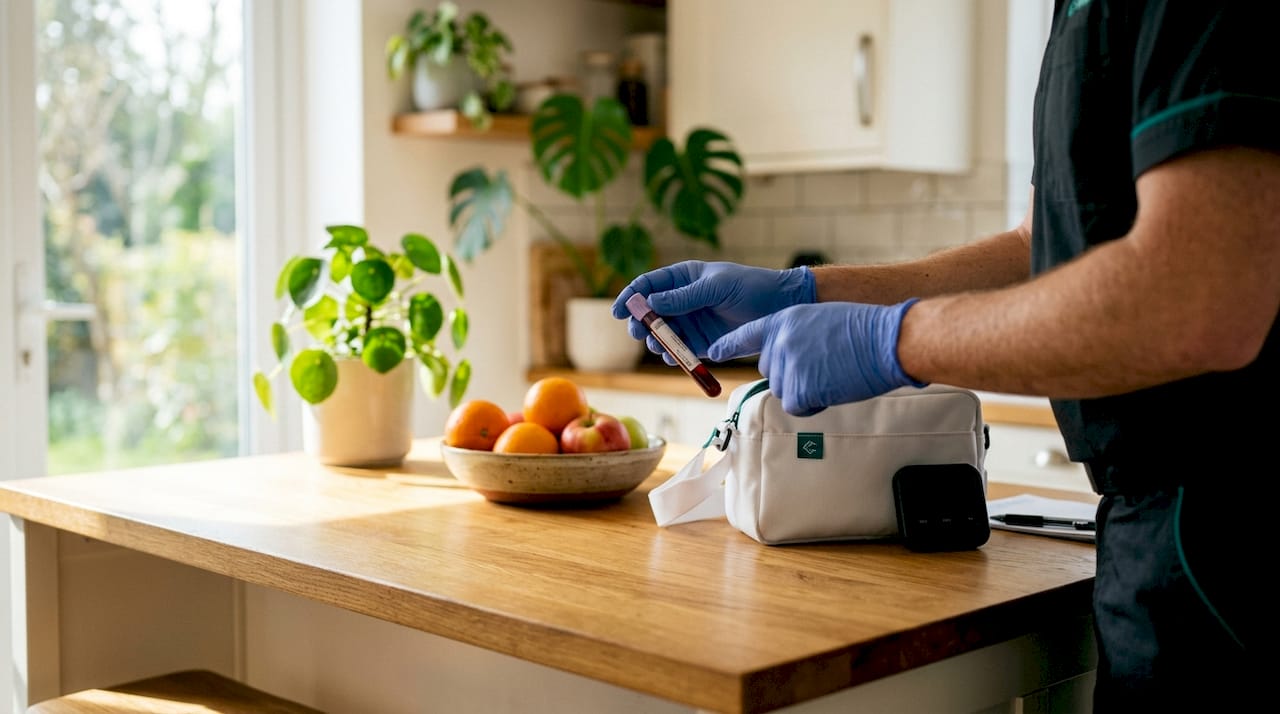
- Biohazard and safety compliance: Couriers receive training in handling Category B biological substances, using personal protective equipment, and managing spill or breakage incidents during transport.
Pro Tip: Require couriers to perform a visual specimen check at the point of collection. Identifying a clotted tube or an unlabeled container before leaving the patient's home prevents a wasted trip and a delayed result.
The role of medical courier in pathology settings adds another layer. Pathology specimens, such as tissue biopsies and cytology samples, often require formalin fixation within a defined window. A courier who understands fixation timelines is a clinical asset, not just a driver.
How do courier services impact lab turnaround times and diagnostic accuracy?
Courier efficiency directly determines how quickly a lab can begin processing a specimen. Reliable courier services reduce delayed or contaminated samples, cutting the need for repeat testing and improving patient satisfaction. That connection between transport quality and diagnostic accuracy is well established in lab operations.
The most common cause of pre-analytical errors is not courier speed. Transport environment failures, including temperature excursions and excessive movement, cause the majority of specimen damage before a sample ever reaches the analyzer. A blood glucose specimen exposed to heat during a 45-minute unrefrigerated ride will produce a falsely low result. A coagulation panel shaken in an unsecured bag may clot prematurely. These are not rare edge cases. They are predictable failures that proper courier training prevents.
The benefits of same-day and STAT courier runs are most visible in urgent care scenarios:
- Faster clinical decisions: Providers ordering sepsis workups, cardiac enzymes, or urgent cultures need results within hours. A same-day courier run shortens the gap between collection and reporting.
- Reduced specimen rejection rates: Specimens that arrive within stability windows require no recollection, saving time for both the lab and the patient.
- Improved patient outcomes: Faster turnaround on home health specimens means medication adjustments, treatment changes, and discharge decisions happen sooner.
The role of courier in lab turnaround is not passive. Couriers who understand specimen stability windows, communicate delays proactively, and flag handling concerns at drop-off function as quality partners rather than transport vendors.
How do you manage multiple lab courier pickups efficiently?
Coordinating multiple lab courier pickups across a home health territory is one of the most demanding operational challenges in lab logistics. Routine scheduled stops, urgent STAT requests, and variable specimen types all compete for the same courier capacity at the same time.
The four most common operational problems are:
- Scheduling conflicts: A courier assigned to a morning route cannot easily absorb a STAT request without disrupting other pickups unless dispatch has real-time visibility into route status.
- Specimen type mismatches: A courier carrying ambient-temperature urine specimens cannot share an insulated cold-chain container with a frozen tissue biopsy without risking temperature contamination.
- Communication gaps: Without a centralized platform, lab staff, couriers, and home health nurses operate on separate communication channels, creating delays and missed pickups.
- Compliance documentation failures: Paper-based logs cannot provide the real-time chain-of-custody visibility that labs and accreditation bodies require.
Centralized management platforms integrate multiple courier partners with dynamic dispatch and real-time tracking to manage urgent and routine pickups without delays. This architecture improves chain-of-custody visibility across the entire network. Labs that schedule courier for home health specimens through these platforms gain the ability to assign pickups by specimen type, monitor courier location, and receive automated alerts when a pickup is running late.
Courier management systems with automated geofencing, route optimization, and predictive ETAs can measurably reduce logistics costs. That reduction reflects fewer repeat pickups, less overtime, and lower specimen rejection rates.
| Challenge | Technology Solution |
|---|---|
| STAT requests disrupting routes | Dynamic dispatch with real-time route adjustment |
| Temperature compliance gaps | Automated geofencing alerts for transit time thresholds |
| Multi-partner coordination | Centralized platform with unified tracking dashboard |
| Paper chain-of-custody logs | Electronic eCOC with timestamped scan events |
Pro Tip: When evaluating platforms to manage multiple lab courier pickups, prioritize systems that allow custom workflows per specimen type. A single workflow applied to all specimens creates compliance gaps for temperature-sensitive or time-critical samples.
What compliance and quality control standards must couriers meet?
Compliance in medical courier operations is not optional, and it is not satisfied by a single certification. Good Distribution Practice (GDP) principles require specialized training, real-time temperature monitoring, and documented handling procedures for every biological sample transported. Labs that use couriers not trained to GDP standards face elevated sample rejection rates and potential patient recall events.
HIPAA adds a second compliance layer. Couriers who handle specimens with patient-identifiable labels are classified as business associates under HIPAA. HIPAA-compliant courier services require signed Business Associate Agreements, accountable employee drivers, and detailed documented workflows that protect patient data confidentiality and chain of custody. A courier company that cannot produce a signed BAA is a regulatory liability for your lab.
The NF S96-900 standard requires complete traceability for biological sample transport from pickup to delivery, with documented proof at each step. This standard formalizes what best-practice labs already expect: real-time monitoring of chain-of-custody and environmental conditions throughout transit.
HIPAA compliance in courier operations demands ongoing audited workflows, accountable employee drivers, and digital eCOC systems for full traceability. Certification alone does not satisfy this requirement. Labs should request audit logs, employee training records, and incident response documentation before engaging any courier partner.
The key compliance requirements for home health lab couriers include:
- Signed Business Associate Agreement with the lab or health system
- Documented GDP training for all drivers handling biological specimens
- Electronic chain-of-custody system with timestamped scan events
- Real-time temperature monitoring for cold-chain specimens
- Background screening and accountability protocols for all courier employees
- Incident reporting procedures for spills, accidents, and specimen loss
HIPAA-aware courier workflows protect both the patient and the lab from data breaches and regulatory violations. Labs that treat compliance as a courier evaluation criterion, rather than an afterthought, reduce their exposure significantly.
Key Takeaways
The courier's role in home health lab logistics determines specimen integrity, diagnostic accuracy, and regulatory compliance at every stage of transport.
| Point | Details |
|---|---|
| Couriers affect diagnostic accuracy | Transport environment failures, not speed, cause most pre-analytical specimen errors. |
| Cold chain management is non-negotiable | Temperature excursions during transit produce false results and require patient recollection. |
| Compliance requires more than certification | HIPAA-compliant couriers must provide signed BAAs, eCOC systems, and audited workflows. |
| Technology reduces operational complexity | Centralized platforms with dynamic dispatch cut logistics costs and improve chain-of-custody visibility. |
| GDP training is the quality baseline | Couriers trained to Good Distribution Practice standards reduce sample rejection and patient recall rates. |
Why I think labs underestimate the courier's role in quality control
Most lab quality programs focus on analyzer calibration, reagent management, and staff competency. The courier rarely appears on a quality audit checklist. That gap is a real problem, and I've seen it produce avoidable failures.
A courier who doesn't understand specimen stability windows is not just a logistics risk. That courier is a pre-analytical variable your QC program cannot control once the sample leaves the collection site. The importance of couriers in healthcare quality programs is consistently underweighted, and labs pay for that oversight in rejected specimens and repeat collections.
The labs that get this right treat their courier partners the way they treat their reference lab partners. They evaluate training records, audit compliance documentation, and hold couriers to the same performance standards they apply internally. They also invest in technology that gives them visibility into what happens between collection and drop-off, because that window is where quality is either protected or lost.
My recommendation for lab administrators is direct: include courier evaluation in your quality management system. Define your specimen stability requirements, communicate them to your courier partner, and verify compliance through eCOC data rather than trust. The courier service onboarding process should be as structured as onboarding any other clinical vendor.
> — Copergrine Editorial Team
***
How Copergrine supports home health lab logistics
Copergrine's home health EMR platform integrates clinical documentation with courier coordination, giving providers a single system for managing specimen orders, transport requests, and delivery confirmation. Lab administrators working across the Greater Houston area can connect telehealth encounters directly to courier dispatch, reducing the gap between a provider ordering a lab draw and a courier arriving at the patient's home.

Copergrine's medical courier service operates with real-time tracking and same-day response capability, supporting both routine home health pickups and urgent STAT requests. The Copergrine EMR supports compliance documentation, chain-of-custody workflows, and provider-to-courier communication in one connected platform. For labs and home health agencies looking to close the gap between clinical care and specimen logistics, Copergrine offers a practical, compliance-ready solution built for the demands of home health settings.
***
FAQ
What is the role of courier in home health labs?
A medical courier in home health labs transports biological specimens from patient homes to clinical laboratories while maintaining chain of custody, temperature compliance, and HIPAA-required documentation. The role directly affects specimen integrity and diagnostic accuracy.
How do couriers affect lab turnaround time?
Couriers who deliver specimens within stability windows allow labs to begin processing immediately, reducing turnaround time and eliminating the need for repeat collections caused by degraded samples.
What compliance standards apply to medical couriers?
Medical couriers must meet HIPAA Business Associate Agreement requirements, Good Distribution Practice (GDP) standards, and electronic chain-of-custody documentation requirements to legally and safely transport patient specimens.
How do you schedule couriers for home health specimens efficiently?
Centralized courier management platforms with dynamic dispatch and real-time tracking allow lab administrators to assign pickups by specimen type, monitor route status, and respond to STAT requests without disrupting scheduled stops.
What is the difference between a standard courier and a medical courier?
A medical courier receives specialized training in biohazard handling, cold chain management, specimen stability, and HIPAA compliance. A standard courier does not carry these qualifications and is not appropriate for transporting patient specimens.
Recommended
- Reducing pre-analytic errors: the courier's role in lab accuracy | Copergrine
- Cold chain compliance basics for outpatient labs: what every lab manager should require from a courier | Copergrine
- How HIPAA-aware courier workflows protect patient samples | Copergrine
- Medical courier for hospitals, labs, and the VA: compliance-ready logistics at scale | Copergrine