
Denial Prevention Billing: A Practical Guide for 2026
Discover effective denial prevention billing strategies. Learn how to minimize claim denials, enhance cash flow, and streamline your revenue cycle.

Denial Prevention Billing: A Practical Guide for 2026
***
> TL;DR: > > - Denial prevention billing stops claim errors at their source before they reach payers. It focuses on front-end controls, AI-driven claim scrubbing, and continuous improvement through root cause analysis. Regular cross-department meetings and leadership support sustain an effective prevention culture.
***
Denial prevention billing is the process of stopping claim denials before they reach the payer by fixing errors at their source. The industry standard term is denial prevention, and it sits at the front end of the broader revenue cycle management discipline. Claim denial rates average 11.8%–12% across US providers, with an estimated $262 billion in denied claims processed annually. The critical fact is that 86%–90% of those denials are fully preventable. Prevention costs a fraction of what appeals and rework cost, and it produces faster, more predictable cash flow. This guide gives billing specialists and healthcare administrators a step-by-step framework for building a prevention-first revenue cycle.

1. Why denial prevention billing starts at the front end
Approximately 41% of denials originate from registration and eligibility errors at the front end of the revenue cycle. That means nearly half of all preventable denials never touch a coder or a biller. They are created the moment a patient is scheduled or checked in with incomplete or incorrect data.
Front-end denial prevention controls include real-time eligibility verification at the time of scheduling, secondary eligibility checks 24–48 hours before the appointment, and hard-stop authorization controls before service delivery. Each control catches a different class of error at the lowest possible cost.
Standardized patient data capture is the foundation. Staff must collect and validate insurance ID numbers, group numbers, subscriber dates of birth, and coordination of benefits status at every visit, not just at initial registration. A single transposed digit in a subscriber ID generates a denial that takes 20–30 minutes to appeal.
Pro Tip: Run a real-time eligibility check at scheduling AND again the morning of the appointment. Last-minute plan changes, lapses, or benefit exhaustions are common and are almost invisible without that second check.
Eligibility issues alone account for 25%–30% of all denials and are the easiest category to eliminate with the right workflow. That single statistic justifies the cost of any real-time verification tool your practice considers.
2. How prior authorization workflows prevent a major denial trigger
Prior authorization failures rank among the top three denial causes across most payer contracts. Automated prior authorization workflows with hard-stop controls embedded in scheduling and order entry reduce missing authorizations to near zero.
The key operational tool is a payer-specific authorization matrix. This is a reference document, ideally embedded in your EMR, that maps each procedure code to its payer-specific authorization requirement. When a clinician orders a service, the system checks the matrix and flags any procedure that requires prior authorization before the order is finalized.
Without this control, authorization requests fall through the cracks during busy scheduling periods. The result is a clean claim that gets denied on the back end for a completely preventable administrative reason. Authorization denials are expensive to appeal because they require clinical documentation and peer-to-peer review.
Updating the authorization matrix quarterly is non-negotiable. Payers change their requirements regularly, and an outdated matrix creates a false sense of compliance. Assign one staff member ownership of the matrix and build the update into the quarterly billing calendar.
3. How claim scrubbing and coding accuracy reduce mid-cycle denial risks
Pre-submission claim scrubbing is the process of running every claim through an automated edit engine before it leaves the practice. Claim scrubbing and coding audits catch code mismatches, missing modifiers, and documentation errors that would otherwise generate technical denials. The result is a higher first-pass acceptance rate and lower rework volume.
The most common mid-cycle denial triggers include:
- ICD-10 diagnosis codes that do not support the medical necessity of the billed CPT procedure
- Missing or incorrect modifiers, particularly for bilateral procedures, assistant surgeons, and distinct procedural services
- National Correct Coding Initiative (NCCI) edit violations, where two codes are billed together but are considered bundled by CMS
- Incomplete documentation of medical necessity, especially for high-complexity evaluation and management (E/M) visits
- Payer-specific billing rules that differ from standard CMS guidelines
AI-enhanced claim scrubbing tools go further than standard edit engines. AI-driven denial prediction tools identify coverage gaps and coding mismatches before submission, giving billers time to correct claims rather than appeal them. These tools analyze historical denial patterns and flag claims that share characteristics with previously denied submissions.
Pro Tip: Build payer-specific rule sets into your claim scrubber. A claim that passes standard CMS edits can still fail a commercial payer's proprietary rules. Payer-specific logic is where most advanced scrubbers earn their cost.
Coding education is equally important. Monthly coding audits, with feedback delivered directly to the responsible coder or clinician, close the loop between documentation quality and billing accuracy. Audits should focus on the top five denial-generating codes for each provider, not a random sample.
4. Leveraging denial data and root cause analysis for continuous improvement
Denial data is only useful when it is organized by root cause, not just by denial reason code. Tracking denials by Claim Adjustment Reason Code (CARC) and grouping them by payer and financial impact reveals which problems are worth solving first.
Fixing the top three denial reasons first, typically eligibility, prior authorization, and registration accuracy, drives the majority of denial reduction success. Practices that apply this prioritization rule reduce denials faster and sustain improvements longer than those that address denials in the order they arrive.
A practical root cause analysis process follows four steps:
- Pull denial data by CARC code for the prior 30 days
- Group denials by payer and calculate the total dollar impact per denial category
- Identify the top three categories by dollar impact, not by volume
- Design a specific workflow intervention for each category and assign an owner
Monthly feedback loops between billing and clinical teams are the mechanism that converts data into prevention. Billing staff know which codes are being denied. Clinical and front desk staff control the documentation and registration processes that generate those codes. Without a structured meeting, those two groups operate in silos and the same denials recur indefinitely.
Key performance indicators for a denial prevention program include first-pass acceptance rate, denial rate by payer, denial write-off rate, and average days to resolution for appealed claims. These four metrics give leadership a complete picture of both prevention effectiveness and back-end recovery performance.
| KPI | What it measures |
|---|---|
| First-pass acceptance rate | Percentage of claims paid on initial submission |
| Denial rate by payer | Frequency of denials per payer contract |
| Denial write-off rate | Revenue lost to unrecovered denials |
| Days to resolution | Average time to resolve an appealed claim |
Pro Tip: Track "shadow denials" separately. These are untracked soft denials and underpayments that never appear in your formal denial queue but quietly erode revenue. Include them in your monthly denial analysis to avoid underestimating your true denial rate.
5. Building a technology stack that supports proactive claims denial prevention
Technology does not replace process. It enforces process at scale. The right technology stack for billing denial management automates the controls that staff would otherwise perform manually and inconsistently.
The four automation layers that matter most are real-time eligibility verification, automated prior authorization tracking, AI-driven claim scrubbing, and predictive denial flagging. Each layer addresses a different stage of the revenue cycle and catches a different class of error.
Healthcare organizations using AI-driven claim scrubbing report up to a 34% reduction in denied claims. That figure reflects the compounding effect of catching errors at multiple points before submission rather than addressing them one at a time after denial.
Integration with your EMR is the critical factor in technology selection. A claim scrubber that operates outside the EMR requires staff to export and import data, creating manual touchpoints where errors are introduced. An EMR-integrated scrubber runs automatically on every claim, with no additional staff action required. The hidden cost of a disconnected EMR shows up directly in staff hours and denial volume.
Automating eligibility verification and authorization controls, combined with targeted coding education, creates a culture of prevention that reduces total touches per claim. Fewer touches mean lower labor cost per claim and faster time to payment.
Staff training on new technology is not optional. A well-configured denial prevention tool used incorrectly produces the same results as no tool at all. Build structured onboarding and quarterly refresher training into every technology implementation plan.
6. Embedding prevention metrics into organizational culture
Successful denial prevention programs embed prevention metrics in performance reviews, fund prevention roles from labor savings, and make denial prevention visible to executive leadership. This is the difference between a denial prevention initiative and a denial prevention culture.
Practices implementing systematic denial prevention workflows recover 70%–85% of denied revenue and reduce denial rates by 30%–50% within six months. Those results require consistent execution across registration, clinical documentation, coding, and billing. No single department achieves them alone.
Leadership must treat denial prevention as a revenue protection function, not a billing department problem. When denial rates appear on executive dashboards alongside patient satisfaction scores and operating margins, prevention gets the attention and resources it requires. Without that visibility, billing teams fight the same fires every month with no structural support.
Denial prevention is most cost-effective when framed as eliminating upstream defects rather than managing back-end appeals. Every dollar spent on prevention saves multiple dollars in rework labor, appeal costs, and write-offs. That framing resonates with finance leadership and builds the case for sustained investment.
Key takeaways
Effective denial prevention billing requires front-end controls, AI-driven claim scrubbing, and monthly cross-department feedback loops working together to eliminate preventable denials before submission.
| Point | Details |
|---|---|
| Front-end errors drive most denials | Fix eligibility and registration workflows first, since 41% of denials originate there. |
| AI scrubbing cuts denials significantly | AI-driven tools reduce denied claims by up to 34% by catching errors before submission. |
| Root cause analysis drives improvement | Track denials by CARC code and address the top three categories by dollar impact each month. |
| Technology must integrate with the EMR | Standalone tools create manual touchpoints; EMR-integrated automation enforces controls on every claim. |
| Prevention requires executive visibility | Embedding denial metrics in leadership dashboards sustains the resources and accountability prevention requires. |
The case for prevention over appeals: a billing specialist's perspective
The billing teams I have worked with over the years share a common frustration. They spend the majority of their time appealing denials that should never have happened. The appeal process is labor-intensive, time-consuming, and often ends in a partial recovery at best. Prevention is not glamorous work, but it is where the real financial gains live.
The shift from denial management to denial prevention requires a cultural change that most organizations underestimate. Billing staff cannot prevent denials they did not cause. Registration errors, missing authorizations, and documentation gaps originate upstream. Getting clinical and front desk teams to own their role in the revenue cycle is the hardest part of any prevention program, and it does not happen without leadership support.
What I have found works is making the data visible and personal. When a clinician sees that their documentation patterns are generating a specific denial category, and that those denials are costing the practice real money, behavior changes. Abstract appeals to "billing accuracy improvement" do not move people. Specific numbers tied to specific workflows do.
The technology piece is real, but it is not a substitute for process discipline. I have seen practices implement sophisticated denial analytics tools and still run 15% denial rates because the underlying workflows were never fixed. The tool surfaces the problem. The team has to solve it.
My practical advice: start with eligibility. Fix that one category completely before moving to the next. The wins are fast, the ROI is clear, and the momentum carries the rest of the program forward.
> — Copergrine Editorial Team
***
How Copergrine's EMR supports your denial prevention program
Copergrine's Copergrine EMR is built with denial prevention woven into the core workflow, not added as an afterthought. The platform includes integrated real-time eligibility verification, automated authorization tracking, and AI-driven claim scrubbing that runs on every claim before submission.
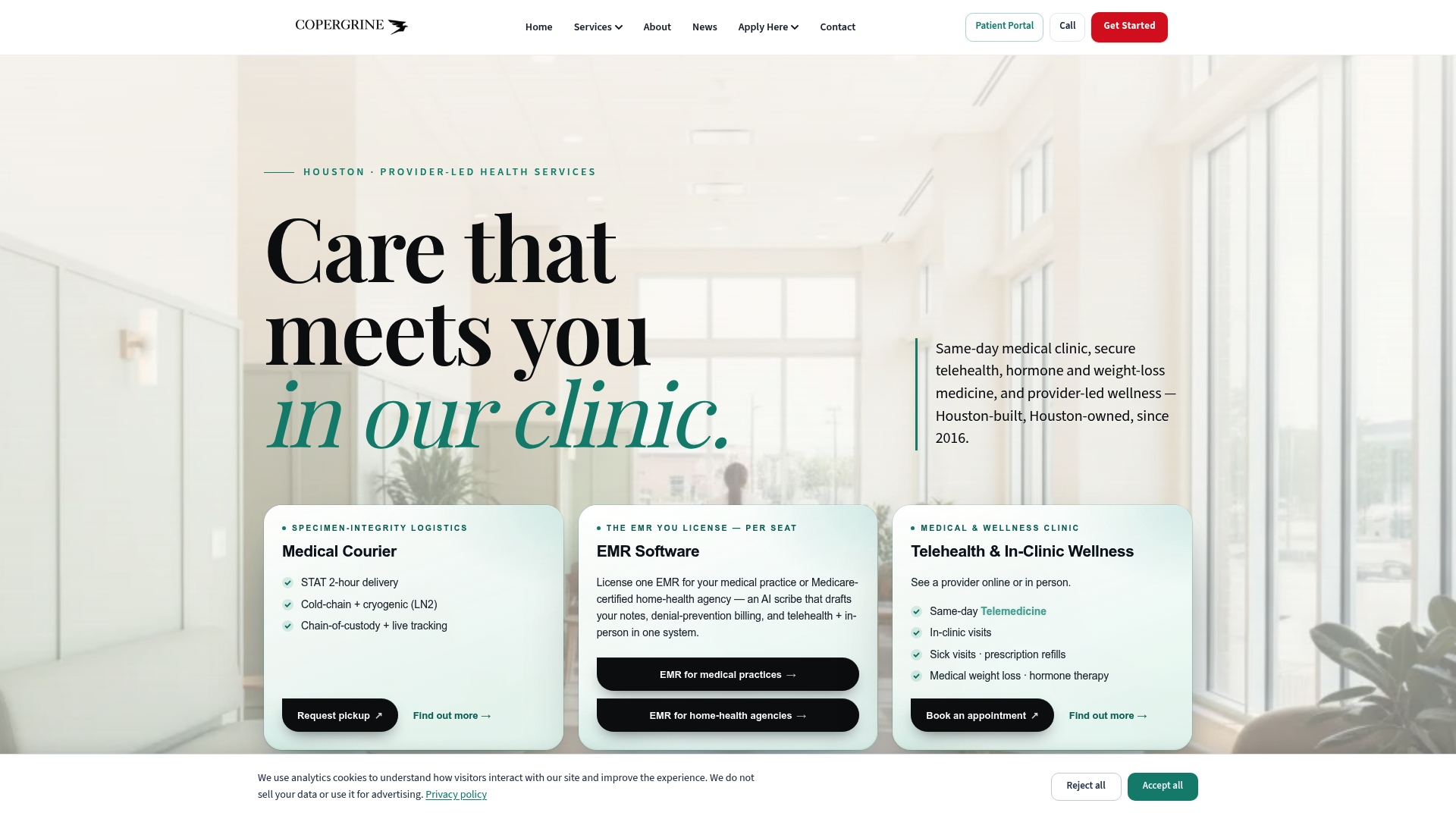
For home health agencies and telehealth practices alike, Copergrine's EMR system connects registration, clinical documentation, coding, and billing in a single environment. That integration eliminates the manual data transfers where errors enter the revenue cycle. Billing specialists get a clean claim queue. Administrators get denial rate dashboards tied directly to workflow performance. If your current system is generating preventable denials, Copergrine's platform is worth a closer look.
FAQ
What is denial prevention billing?
Denial prevention billing is the practice of identifying and correcting claim errors before submission to avoid payer rejections. It addresses root causes at registration, authorization, coding, and documentation stages rather than managing denials after the fact.
What percentage of claim denials are preventable?
Between 86% and 90% of claim denials are considered fully preventable with proper front-end controls and pre-submission claim scrubbing. Eligibility and registration errors alone account for 25%–41% of all denials.
How does AI improve denial prevention in medical billing?
AI-driven claim scrubbing and denial prediction tools analyze coding patterns and coverage data before submission, reducing denied claims by up to 34%. These tools flag high-risk claims for review before they leave the practice.
What are the most important denial prevention KPIs?
First-pass acceptance rate and denial rate by payer are the two most critical metrics. Denial write-off rate and average days to resolution complete the picture for both prevention effectiveness and back-end recovery.
How often should billing and clinical teams meet to review denial data?
Monthly feedback meetings between billing and clinical or front desk teams are the standard for effective denial prevention. This cadence converts denial data into workflow corrections before patterns become entrenched.