
Documentation built by discipline
PT, OT, and SLP templates capture discipline-specific findings, timed CPT minutes, signatures, co-signatures, and immutable addenda.
Lead vertical · PT · OT · SLP
Run adult and pediatric PT, OT, and SLP with discipline-specific documentation, measurable outcomes, home exercise programs, and therapy-aware billing on one Copergrine® platform.
From $229 first 6 mo · from $380 after, per Medicare enrollment (PTAN) at 1–30 clients
The note your therapist actually writes
ROM, strength/MMT, gait device and assist, transfers, balance, and interventions are first-class fields on a PT evaluation — with the AI scribe drafting and the licensed therapist reviewing and signing. Nothing auto-signs.
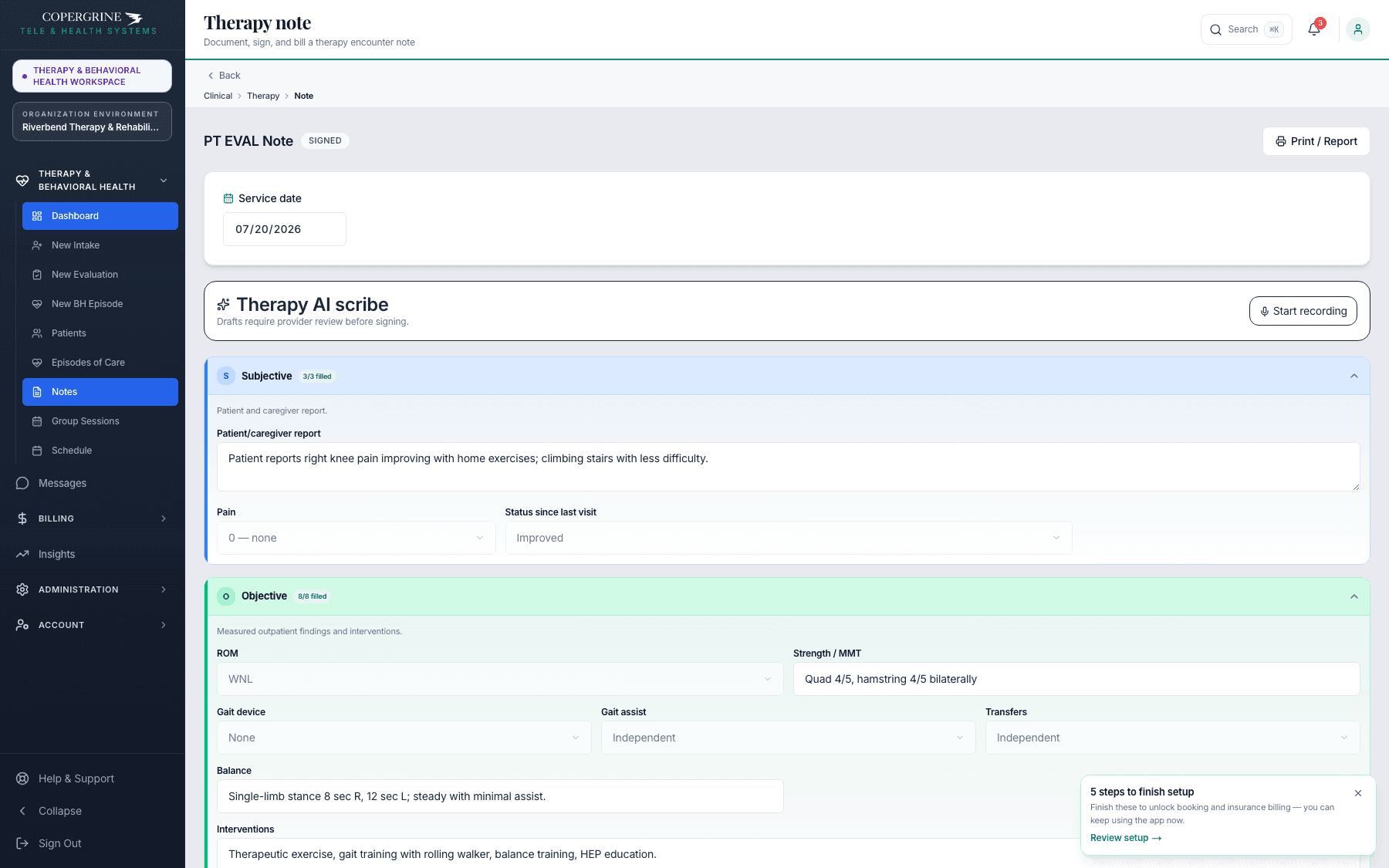
Signed PT evaluation — Subjective 3/3, Objective 8/8
AI drafts; the licensed therapist reviews and signs. Every note is billable-ready and auditable.
One clinical and revenue-cycle spine
PT, OT, and SLP templates capture discipline-specific findings, timed CPT minutes, signatures, co-signatures, and immutable addenda.
Copergrine drafts structured therapy-note sections. The licensed clinician reviews, edits, and signs.
Standardized assessment capture and auto-scored outcome measures keep evaluation findings and progress trends in the chart.
A six-step evaluation wizard moves from referral and evaluation through assessments, goals, plan of care, HEP, review, and signature.
Professional 837P therapy billing checks timed units against the CMS 8-minute-rule, discipline modifiers, assistant modifiers, and review gates before submission. Outpatient rehab claims are produced, but the therapy-specific scrub is coder-gated. The 8-minute / KX / MPPR rule pack is built, unit-tested, and RUNS on every therapy claim the system generates. What is gated is ENFORCEMENT: no org is opted in, so every therapy claim still carries the certified-coder review warning, and two of the four CMS figures the rule pack consults are signed off and two are not. Crossing a threshold whose figure IS signed off blocks the claim; crossing one that is not HOLDS it for a certified coder instead. 837P generation itself works — expect a claim, and expect the therapy-specific scrub to have run on it and recorded its findings there.
Ambient AI drafts structured notes from visits. The licensed clinician reviews, edits, and signs.
Real-time eligibility, claim scrubbing, prior-authorization holds, timely-filing enforcement, and remittance reconciliation share one revenue cycle.
Recurring provider schedules support multiple locations and in-person, video, and audio visit modalities.
Encrypted intake, messaging, statements, records, and documents keep patients connected to the same chart.
Structured charting, e-signature, co-sign workflows, immutable addenda, and SOC 2-aligned audit trails are built in.
Clinical documentation, scheduling, eligibility, claims, and patient access run on Copergrine EMR.
AI in clinical work
The AI scribe drafts structured notes and coding grounded to the live code catalog. Every AI artifact is provenance-logged, and nothing auto-signs.
No. It is positioned for PT, OT, and SLP practices serving adults and children across the lifespan, including adult orthopedic, neurological, and geriatric care.
Yes. The AI scribe drafts structured notes, and the licensed clinician reviews and signs.
Copergrine includes real-time eligibility, CPT/ICD/modifier/units claim scrubbing, prior-authorization holds, timely-filing enforcement, and remittance reconciliation.
From $229 per Medicare enrollment (PTAN) per month for your first 6 months at 1–30 clients, stepped by active client census; from $380 per month thereafter. Unlimited clinicians and staff — headcount is not a price input.
Active clients on the enrollment: any client with an active episode of care on the billing date. Each client counts once. Discharged clients drop off at the next billing cycle. One unit per Medicare enrollment (PTAN) on a Type-2 NPI — rehab agency, CORF/ORF, CMHC, or group practice. A practice still working through enrollment licenses one unit keyed on its NPI.