
How to Evaluate Medical Courier Reliability Metrics
Learn how to evaluate medical courier reliability metrics effectively. Discover key indicators that ensure high-quality patient care.

How to Evaluate Medical Courier Reliability Metrics
***
> TL;DR: > > - Reliable medical courier metrics include on-time delivery, specimen integrity, and STAT response times that directly impact patient care. A structured, data-driven evaluation process with regular reviews helps prevent operational failures and ensures accountability. Relying on transparent performance data and continuous monitoring leads to better courier selection and improved healthcare logistics.
***
Medical courier reliability metrics are the quantifiable performance indicators healthcare administrators use to verify that a courier service meets the delivery standards patient care demands. Evaluating these metrics correctly separates couriers that protect clinical outcomes from those that create costly operational failures. The core indicators include on-time delivery rate, specimen integrity rate, STAT response time, driver retention, and billing accuracy. Each one maps directly to a patient care risk. This guide explains which metrics matter most, how to measure them accurately, and how to build a data-driven evaluation process that holds courier partners accountable.
What are the key reliability metrics to evaluate medical courier services?
On-time delivery rate is the most cited metric in courier performance assessment, and the benchmark gap between service tiers can be significant. Specialized medical couriers should generally outperform general couriers on this measure. That difference directly affects diagnostic timelines and the clinical decisions that follow.

Specimen integrity rate measures how often samples arrive in a condition suitable for analysis. Specimen rejection rates attributable to transport issues should remain very low for reputable specialized couriers. Temperature excursions, improper packaging, and chain-of-custody breaks are the primary causes of specimen failure, and each one is preventable with proper courier protocols.
STAT response time defines how quickly a courier can dispatch and complete an urgent delivery. For hospitals and labs, a 2-hour STAT window is the accepted operational standard in many markets. Couriers that cannot document their average STAT response time with actual data should not be considered for time-sensitive clinical routes.
Driver quality metrics are often overlooked but carry real operational weight. Driver turnover can be high in the medical courier industry. High turnover disrupts route familiarity, compliance training continuity, and the institutional knowledge that keeps pickups and deliveries running without incident.
Billing accuracy functions as an indirect reliability signal. Inaccurate invoices generate hidden administrative costs for every dispute. A courier that cannot bill correctly is often a courier that cannot track performance correctly either.
Pro Tip: Ask any courier candidate to provide specimen rejection logs segmented by transport condition, not just aggregate on-time delivery percentages. Segmented data reveals handling quality that summary statistics hide.
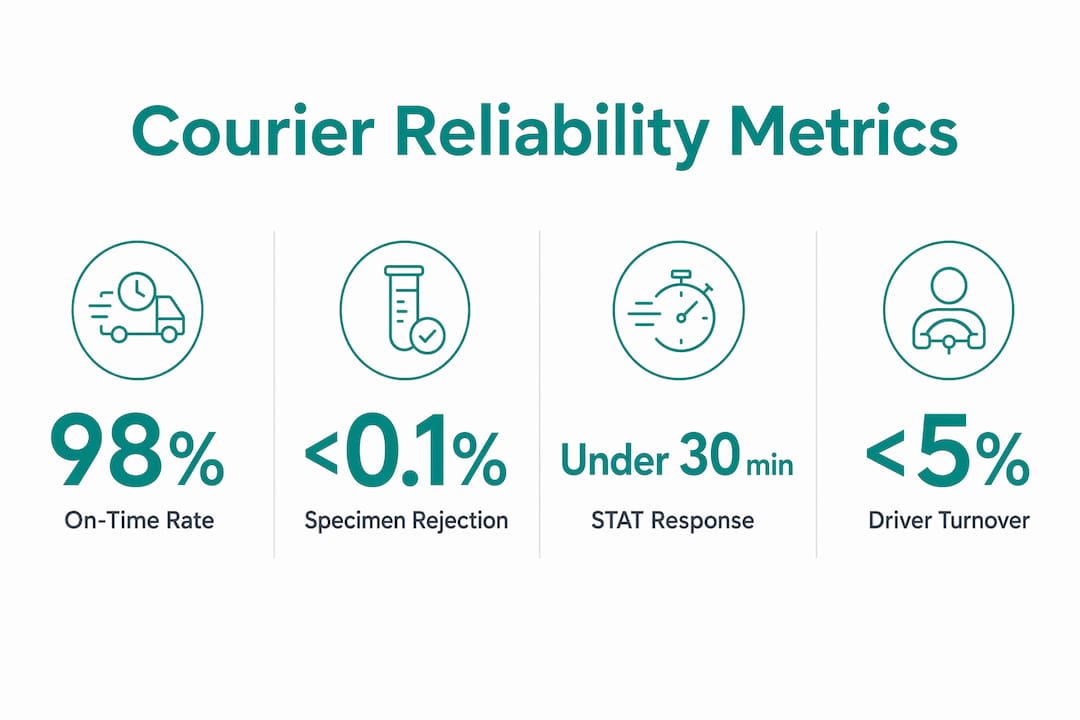
How to establish a data-driven evaluation process for courier reliability
A structured evaluation process replaces guesswork with documented evidence. Switching from gut-feel assessments to data-driven scorecards can measurably reduce hidden service failures and surface billing dispute costs that most administrators never track. The process below gives you a repeatable framework.
Step 1: Define your KPIs before you contact any vendor. Set minimum acceptable thresholds for on-time delivery rate, specimen rejection rate, STAT response time, and driver tenure. Document these thresholds in writing before vendor conversations begin.
Step 2: Demand measurement methodology, not just numbers. On-time delivery statistics should be measured from initial parcel scan to final delivery confirmation, excluding only documented external factors like severe weather. Any vendor that cannot explain how they calculate their on-time rate is likely reporting a number that flatters their performance.
Step 3: Build a vendor scorecard. Assign weighted scores to each KPI based on your facility's priorities. A hospital lab will weight specimen integrity and STAT response more heavily than a clinic running routine supply deliveries.
Step 4: Set reporting intervals and review meetings. Quarterly formal reviews are the minimum standard for active courier partnerships. Monthly data pulls during the first six months of a new contract allow you to catch performance drift before it affects patient care.
Step 5: Integrate real-time tracking into your workflow. Couriers that provide GPS tracking and temperature logging give you live visibility into delivery status. This data also feeds your scorecard automatically, reducing the administrative burden of manual reporting.
Pro Tip: Require that all performance data be delivered in a format you can import into a spreadsheet or your EMR system. Vendor-formatted PDF reports make independent analysis difficult and slow down quarterly reviews.
Technology integration is a practical differentiator when comparing courier candidates. Couriers that connect their tracking systems directly to your HIPAA-aware workflows reduce both compliance risk and the time your staff spends chasing delivery confirmations.
What common pitfalls should you avoid when assessing courier reliability?
The most damaging mistake administrators make is accepting a quoted on-time delivery rate without asking how it was calculated. A courier claiming 100% on-time delivery almost certainly excludes delays attributed to weather, traffic, or facility access. Stated percentages without disclosed methodology indicate unreliable reporting. Always ask for the definition behind the number.
Overlooking specimen rejection logs is equally costly. Aggregate on-time metrics tell you nothing about what arrived in a usable condition. Specimen rejection logs segmented by transport conditions provide direct evidence of courier handling quality and its effect on clinical outcomes. If a vendor cannot produce these logs, that absence is itself a data point.
Ignoring driver retention data creates a blind spot in your reliability assessment. A courier with high driver turnover may perform well in the first month of a contract, then degrade as experienced drivers leave and untrained replacements take over routes. Ask specifically whether drivers are employees or independent contractors, since contractor models typically produce higher turnover.
Failing to differentiate performance by service lane is another common error. A courier may excel on standard daily routes but underperform on STAT or after-hours deliveries. Evaluate performance data by urgency level and route type, not as a single blended figure.
> "The cost of choosing the wrong courier partner outweighs upfront price savings." Administrators who prioritize the lowest bid over documented performance data consistently face higher total costs from delayed diagnoses, rejected specimens, and billing disputes.
Not accounting for the downstream cost of delivery failures is the final and most expensive oversight. A single delayed STAT specimen can require a repeat blood draw, extend a patient's diagnostic wait, and generate additional lab fees. The true cost of a missed delivery extends well beyond the courier invoice.
How to compare and choose the right medical courier based on reliability data
A composite scorecard is the most reliable tool for comparing courier candidates. Weight each metric category according to your facility's clinical priorities, then score each vendor against your documented thresholds. This approach removes price bias and forces an evidence-based decision.
| Evaluation category | Specialized medical courier | General courier service |
|---|---|---|
| On-time delivery rate | Consistently high | Often lower or less specialized |
| Specimen integrity rate | Very low failure rate | Not typically tracked |
| STAT response capability | Documented 2-hour windows | Not standard |
| Driver retention | Employees with medical training | High contractor turnover |
| Temperature logging | Standard with chain of custody | Rarely available |
| Billing transparency | Per-delivery pricing with itemized fees | Variable, often bundled |
Specialized medical couriers and general courier services differ on nearly every metric that matters for healthcare logistics. Per-delivery pricing models with itemized base pickup fees, mileage, and urgency multipliers give administrators the cost transparency needed to budget accurately and identify billing anomalies quickly.
Compliance and security are non-negotiable baseline criteria. Any courier handling clinical specimens must operate within HIPAA-aware chain-of-custody protocols. Couriers that cannot demonstrate documented compliance training for their drivers should be disqualified regardless of their quoted on-time rate.
Scalability matters when your facility's volume changes. Evaluate whether a courier can absorb a 30% increase in daily pickups without degrading STAT response times. Ask for documented examples of how they have managed volume surges for existing clients.
Pro Tip: Run a 90-day pilot with any new courier on a defined subset of routes before committing to a full contract. Pilot data gives you real performance evidence under your specific operational conditions, not just the vendor's historical averages.
Health logistics analysts emphasize that ongoing vendor performance reviews focused on STAT times and specimen handling logs better protect patient care than one-time cost comparisons. Treat courier selection as the start of a performance partnership, not a procurement transaction.
Key Takeaways
Rigorous, data-driven courier evaluation requires tracking on-time delivery, specimen integrity, STAT response, driver retention, and billing accuracy as a connected set of metrics, not isolated figures.
| Point | Details |
|---|---|
| Benchmark on-time delivery | Specialized medical couriers should consistently outperform general couriers on on-time delivery. |
| Demand specimen rejection logs | Segmented transport logs reveal handling quality that aggregate on-time statistics cannot show. |
| Verify metric methodology | Always ask how on-time delivery is calculated; unverified percentages indicate unreliable reporting. |
| Track driver retention | High turnover signals operational instability and compliance training gaps. |
| Conduct quarterly reviews | Formal performance reviews every quarter catch service drift before it affects patient outcomes. |
What I've learned from watching administrators pick the wrong courier
The pattern I see most often is this: an administrator selects a courier based on a quoted on-time rate and a competitive price, then spends the next six months managing specimen rejections, billing disputes, and missed STAT windows. The number on the proposal looked good. The methodology behind it was never questioned.
Rigorous, transparent metric tracking is not bureaucratic overhead. It is the mechanism that prevents costly operational surprises from becoming patient care failures. The administrators who get this right build scorecards before they issue RFPs, not after the first service failure.
Technology has made real-time reliability monitoring genuinely accessible. GPS tracking, temperature logging, and automated delivery confirmation are now standard features among specialized medical couriers. If a vendor cannot offer these capabilities, they are not operating at the level healthcare logistics requires in 2026.
The most productive courier relationships I have observed treat evaluation as an ongoing dialogue, not a one-time vendor selection event. Quarterly reviews with open data sharing create accountability on both sides. They also give administrators early warning when a courier's performance is trending downward, before a single missed delivery becomes a systemic problem.
The administrators who view courier evaluation as a continuous process consistently report fewer operational disruptions and lower total logistics costs than those who revisit the question only when something goes wrong.
> — Copergrine Editorial Team
***
Copergrine's approach to medical courier performance in Houston
Copergrine operates a dedicated medical courier service in the Greater Houston area, built around the performance standards healthcare administrators require. Real-time GPS tracking, temperature chain-of-custody documentation, and HIPAA-aware delivery protocols are standard across every route.

Copergrine's courier service integrates directly with its proprietary EMR platform, giving healthcare providers a single system for managing clinical documentation and logistics performance data. Administrators gain visibility into delivery confirmations, specimen handling records, and route-level performance without switching between disconnected tools. For facilities that need same-day STAT delivery alongside compliant clinical documentation, Copergrine provides both under one connected platform.
***
FAQ
What is a good on-time delivery rate for a medical courier?
A reputable specialized medical courier should maintain a consistently high on-time delivery rate and outperform general courier services, a gap that directly affects diagnostic timelines.
How should specimen integrity be measured in courier evaluations?
Specimen rejection rates attributable to transport issues should remain very low for specialized medical couriers. Request rejection logs segmented by transport condition, not just aggregate delivery statistics.
Why does driver turnover matter in medical courier reliability?
Driver turnover can be high in the medical courier industry. High turnover disrupts route familiarity and compliance training continuity, both of which affect delivery reliability and specimen handling quality.
How often should healthcare administrators review courier performance?
Quarterly formal reviews are the minimum standard for active courier partnerships. Monthly data pulls during the first six months of a new contract allow administrators to identify performance issues before they affect patient care.
What does a reliable courier pricing model look like?
Specialized medical couriers typically use per-delivery pricing with itemized base pickup fees, mileage charges, and urgency multipliers. This structure supports cost transparency and makes billing anomalies easier to identify and dispute.
Recommended
- How to evaluate a medical courier's reliability before you commit | Copergrine
- Medical courier for hospitals, labs, and the VA: compliance-ready logistics at scale | Copergrine
- What practices and clinics should expect from a dedicated medical courier partner | Copergrine
- 5 signs your lab needs a dedicated medical courier partner in Houston | Copergrine